

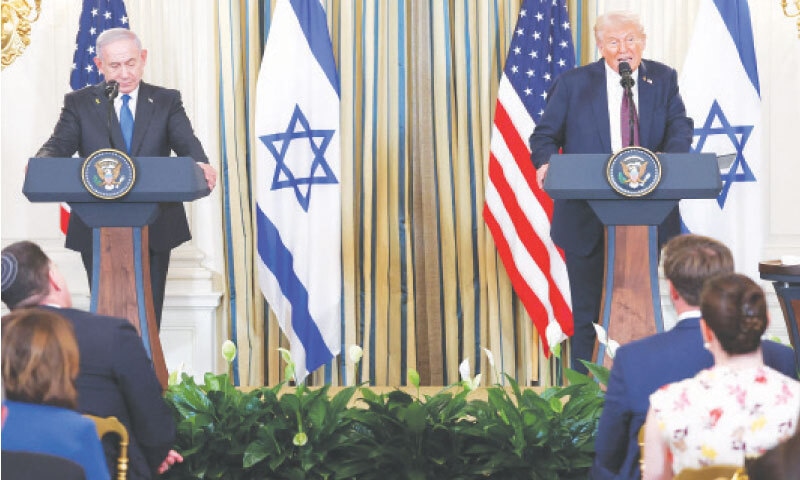
Washington, D.C.
In a high-stakes press conference at the White House, President Donald Trump unveiled his long-awaited plan aimed at resolving the conflict in Gaza, stating that Israeli Prime Minister Benjamin “Bibi” Netanyahu is “very close” to agreeing to the deal. Standing alongside the visiting Israeli leader, Trump framed the proposal as part of a larger, ambitious push for what he termed “eternal peace in the Middle East.”
President Trump acknowledged the global coalition involved in developing the plan, specifically thanking leaders from Arab and Muslim nations. He singled out Pakistan, claiming that Prime Minister Shehbaz Sharif and Field Marshal Asim Munir had been with the initiative “right from the beginning” and backed the pact “100 per cent.”
In a corresponding post on X, PM Shehbaz had welcomed the US President’s “20-point” plan, praising Trump’s leadership and reaffirming his “firm belief that President Trump is fully prepared to assist in whatever way necessary to make this extremely important and urgent understanding to become a reality.”
A joint statement from the foreign ministers of eight Muslim nations—including Saudi Arabia, Pakistan, Turkey, and Qatar—welcomed Trump’s efforts, affirming the bloc’s readiness to engage positively and constructively towards finalizing and implementing the agreement.
Immediate Hostage Release and Hamas’s Future
The plan’s immediate priority, according to Trump, is the release of all remaining hostages within a maximum of 72 hours, pending Hamas’s acceptance.
The most critical and controversial element, however, addresses future security and governance. Trump stated that Arab and Muslim countries have committed to a swift process to demilitarize Gaza, decommissioning the military capabilities of Hamas and all other “terror organizations.”
“Working with the new transitional authority in Gaza, all parties will agree on a timeline for Israeli forces to withdraw in phases,” Trump said. He added a stark warning to the militant group: “If Hamas rejects the deal, which is always possible… as you know Bibi, you have my full backing to do what you have to do.”
The proposal mandates the dismantling of “terror infrastructure,” including tunnels and weapons production facilities, and the training of local police forces in the Gaza Strip.
New Oversight Body and Statehood Uncertainty
To oversee the implementation and reconstruction effort, Trump announced the creation of a new international oversight body called the ‘Board of Peace’. This body, he said, would be led by Arab leaders, Israel, and Trump himself, with former UK Prime Minister Tony Blair named as a potential member.
The plan calls for the creation of a temporary International Stabilisation Force (ISF), comprised of US, Arab, and international partners, which will immediately deploy to train law enforcement, secure borders with Israel and Egypt, and prevent munitions from entering the besieged Palestinian enclave.
Crucially, Trump stated that the World Bank would be charged with recruiting a new Palestinian government composed of “highly qualified experts from around the world,” explicitly excluding any role for Hamas or other militant groups in the governance of Gaza.
While the deal aims for regional normalization—with Trump suggesting Iran could eventually become a member of the Abraham Accords—he conceded that PM Netanyahu “remains opposed to a Palestinian state.” This opposition leaves the core political future of the Palestinian people deeply unresolved, even as the international community prepares to push for implementation. Hamas officials confirmed receiving the 20-point proposal from Qatari and Egyptian mediators in Doha.
