

Islamabad / Washington
Just a day after US President Donald Trump unveiled his ambitious 20-point plan aimed at ending the war in Gaza, clear signs have emerged that the draft, made public by the White House, is meeting staunch opposition from key regional allies.
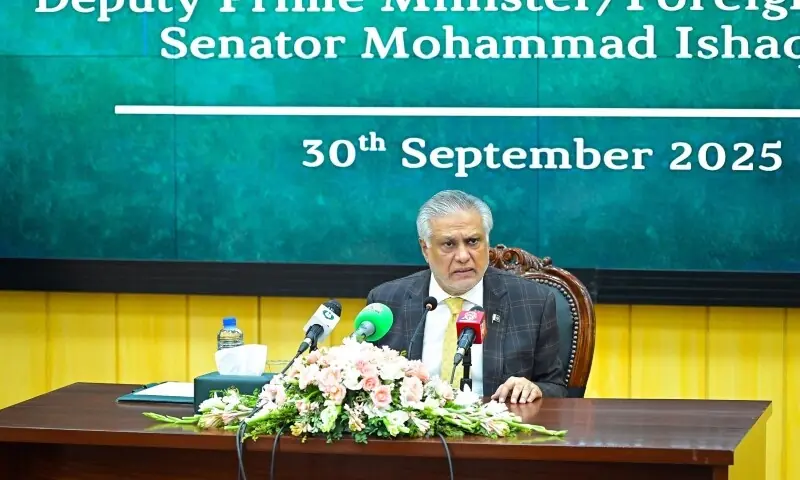
The discontent was evident during Foreign Minister Ishaq Dar’s press conference on Tuesday, where he stated unequivocally that the US peace plan would be unacceptable unless amendments jointly proposed by eight Muslim countries were fully incorporated.
Despite Trump’s prior claims that both Prime Minister Shehbaz Sharif and Field Marshal Asim Munir were “100pc” behind the deal, Dar visibly distanced Pakistan from the document. “This is not our document, which we sent to them. The document has been issued by the US,” he stressed. He added that Pakistan “owned” the joint statement issued by the eight Muslim nations, positioning it as the definitive red line for engagement.
The core demands conveyed to Trump by the Muslim leaders involved an immediate ceasefire, unhindered humanitarian aid, a cessation of the forced displacement of Palestinians, arrangements for refugee return, planning for Gaza’s reconstruction, and halting Israel’s attempts to annex the West Bank.
The Foreign Minister confirmed the plan envisions an independent technocrat government for Palestinians, overseen by an international body predominantly comprised of Palestinians. Regarding the proposed International Stabilisation Force (ISF), Dar was guarded but noted that Indonesia had offered 20,000 troops, with Pakistan’s leadership set to decide on its participation.
The Hidden Rift: Netanyahu’s Intervention
The public protest from Islamabad is being viewed as a “mild protestation” over significant last-minute changes to the terms of the deal, which were reportedly secured by Israeli Prime Minister Benjamin Netanyahu.
According to reports from the US news outlet Axios, the plan presented to Hamas is fundamentally different from the one initially agreed upon by the US and the group of Arab and Muslim countries. The primary stumbling blocks were edits secured by Netanyahu during an intensive meeting with White House envoys.
These changes included making Israel’s withdrawal timetable conditional on the progress of disarming Hamas, and crucially, giving Israel veto power over the process. Axios reported that even after all withdrawal phases are completed, Israeli forces would remain within a security perimeter “until Gaza is properly secure from any resurgent terror threat.”
Behind the scenes, officials from Saudi Arabia, Egypt, Jordan, and Turkiye were reportedly furious over the changes. Qatar even attempted to convince the Trump administration not to release the detailed plan due to these core objections. Consequently, the eight Muslim countries issued a joint statement welcoming Trump’s announcement, but pointedly refrained from expressing full support for the final text.
Hamas Deadline and Two-State Principle
Following the sharing of the 20-point plan with Hamas, President Trump issued a blunt ultimatum, giving the group “three to four days” to accept the proposal or face “a very sad end.”
A source close to Hamas told Reuters the plan was “completely biased to Israel” and imposed “impossible conditions” aimed at eliminating the group. A senior Hamas figure told the BBC that the group is highly unlikely to agree to disarming and handing over their weapons.
Despite the deep division over the contents of the US plan, Foreign Minister Dar maintained that Pakistan’s long-standing policy on Palestine remains unchanged, affirming their unwavering commitment to the two-state solution. He stressed that this commitment is shared by the seven other Muslim nations involved in the negotiations, positioning the demand for a sovereign Palestinian state as non-negotiable.
