

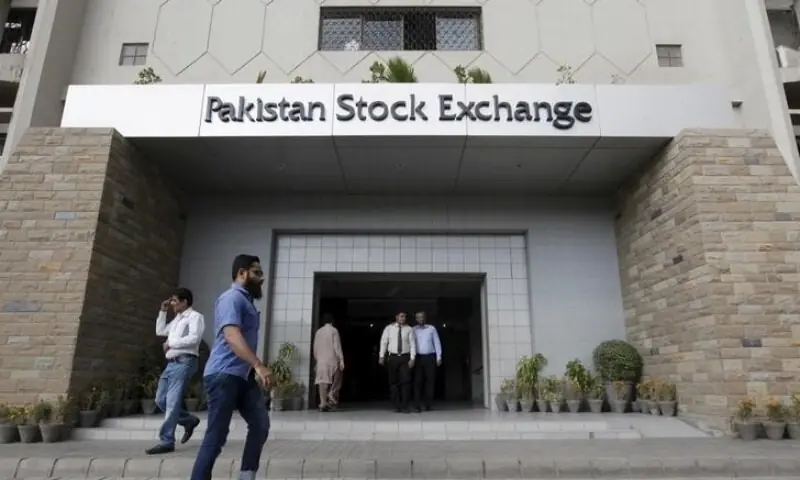
KARACHI, PAKISTAN:
The Pakistan Stock Exchange (PSX) achieved a significant historic milestone on Tuesday, with its benchmark KSE-100 index breaching the 166,000-point threshold for the first time. This sustained upward trajectory signals the growing confidence of the business community in the government’s economic policies and broader signs of national economic recovery.
The KSE-100 index soared to an intraday peak of 166,556.29 points, marking a substantial gain of 2,708.61 points, or 1.65 percent. Despite fluctuations, the index concluded the day at 165,493.58 points, securing a net gain of 1,645.90 points (1%).
This was the third consecutive day of record-setting activity, fueled largely by an appetite for risk and fresh capital injection. Samiullah Tariq, head of research at Pak Kuwait Investment Company Ltd, noted that the market’s surge is being driven by “Strong corporate results and additional liquidity in the market, with a preference for equities.”
Underlying Drivers of Market Optimism
The bullish rally is rooted not just in domestic enthusiasm but in significant geopolitical and economic developments. These include the finalization of a Rs1.275 trillion financing facility with commercial banks to tackle the power sector’s crippling circular debt, alongside a strategic defence agreement with Saudi Arabia, which has raised expectations for enhanced bilateral trade and financial support.
Yousuf M. Farooq, director of research at Chase Securities, characterized the current sentiment as a “firmly optimistic phase,” supported by tangible “signs of an economic recovery and a steadily improving geopolitical news flow.” He pointed out that the rally is being powered by sustained mutual fund inflows combined with fresh participation from retail investors.
Crucially, all eyes are currently fixed on the ongoing International Monetary Fund (IMF) review. Most market participants remain hopeful for a smooth conclusion to the review. Awais Ashraf, director of research at AKD Securities, added that investors are “optimistic” about the potential for foreign direct investment, citing improved diplomatic relations with key partners like the United States and Saudi Arabia.
While the government enters this crucial stage of negotiations with the IMF, investor confidence hinges on the positive outcome of the review. However, a lingering layer of caution remains among some analysts, who note that achieving the challenging fiscal targets set by the IMF is essential for solidifying Pakistan’s long-term economic stability.
