

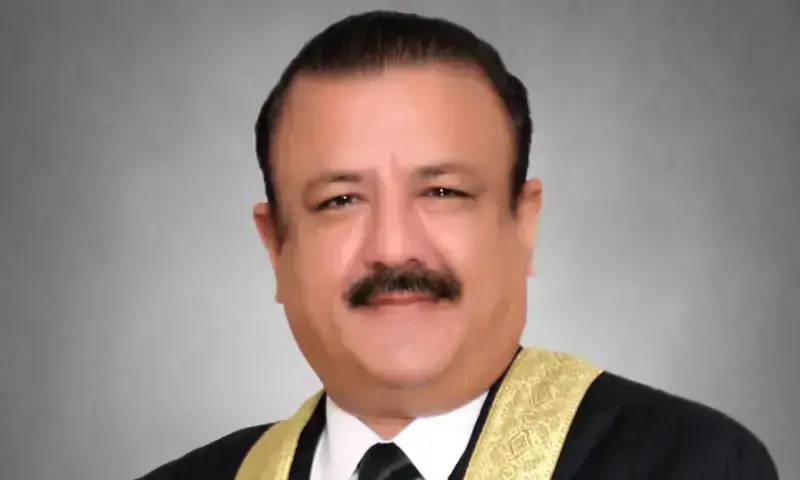
ISLAMABAD, PAKISTAN – The Supreme Court of Pakistan has moved to suspend an unprecedented order by the Islamabad High Court (IHC) that restrained Justice Tariq Mehmood Jahangiri from exercising his judicial powers. The decision came during the hearing of a petition challenging the IHC’s interim order, which was issued amid an ongoing controversy over the validity of the judge’s law degree.
A five-member constitutional bench of the Supreme Court, led by Justice Aminuddin Khan, ruled that the “operation of the impugned order is suspended.” Recognizing the gravity of the legal issue, the bench issued notices to all respondents, the attorney general of Pakistan, and the advocate general Islamabad, noting that the matter “relates to the interpretation of provisions of the Constitution.” The hearing was adjourned until the following day.
The controversy stems from a complaint filed with the Supreme Judicial Council (SJC) in July last year and a separate petition filed in the IHC challenging Justice Jahangiri’s appointment. The core issue revolves around a letter circulated on social media, purportedly from the University of Karachi (KU), questioning the judge’s law degree due to anomalies in enrollment numbers.
Legal Precedent and Argument
The IHC had taken the highly unusual step on September of barring one of its own judges from judicial work. Challenging this, Justice Jahangiri’s lawyer, Munir A. Malik, argued before the Supreme Court that this was the first instance of a two-member bench restraining a judge of its own high court from judicial work. He contended that the order violated the law and denied justice.
Malik further pointed out that the writ petition against Justice Jahangiri, filed over a year ago, still had pending objections from the registrar’s office. He highlighted a recent Supreme Court order establishing that only the SJC holds the constitutional authority to probe misconduct allegations against judges, reinforcing the argument that the IHC lacked the jurisdiction for such a restraining order.
The Degree Controversy
The legal drama over the degree intensified last year when the KU letter—reportedly a response to a Right to Information application—indicated that while the degree was not declared bogus, it was deemed “invalid” due to the impossibility of a student having two enrollment numbers for the same degree program.
In a dramatic turn in September , the KU Syndicate formally cancelled Justice Jahangiri’s degree and enrollment. However, the Sindh High Court (SHC) later suspended KU’s revocation on the grounds that the university had acted without affording the judge an opportunity to defend himself.
The Supreme Court bench, during today’s proceedings, raised a critical question regarding procedural fairness: Justice Hassan wondered how the original plea against Justice Jahangiri was fixed for hearing in the IHC when objections were still pending with the registrar’s office. Both sides were directed to prepare arguments on this procedural irregularity for tomorrow’s hearing.
