

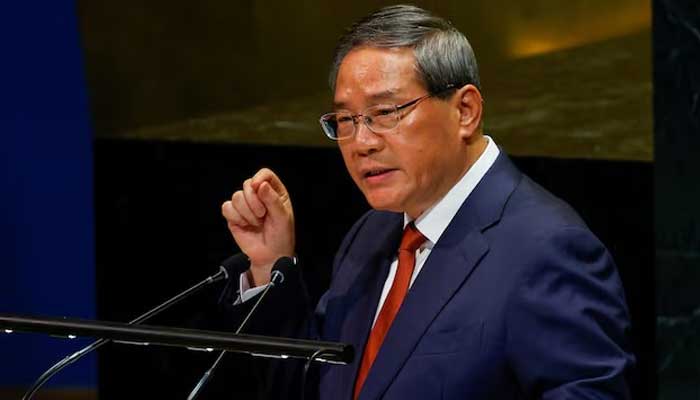
Chinese Premier Li Qiang has cautioned the world, in remarks seemingly directed at Washington without naming the country, against the dangers posed by the imposition of civilisational superiority, unilateralism, and high tariffs.
Speaking at the United Nations General Assembly (UNGA), Li Qiang asserted that: “A major contributor to the current global economic doldrums is the surge in unilateral and protectionist actions, such as tariff increases and the construction of walls and barriers. Ultimately everyone will be worse off.”
Li Qiang championed a collaborative strategy, urging nations to expand their convergence of interests and promote inclusive economic globalization. He equally stressed the importance of interaction among civilizations, stating that an obsession with so-called “civilisational superiority” or the formation of ideology-based circles only serves to breed more division and confrontation. The Premier used the Chinese proverb, “a single flower does not make spring; one hundred flowers in full blossom bring spring to the garden,” to convey this message to the august gathering.
Global Initiatives and Economic Ascendancy
Li Qiang highlighted China’s extensive Belt and Road Initiative (involving over countries) and Beijing’s leading role in international cooperation on sci-tech innovation, including the sharing of crucial technologies like and AI to accelerate global development. He reminded the Trump administration that, “China has consistently opened its door wider to the world. It has lowered its overall tariff level to and remained the world’s second largest importer for consecutive years.”
These pointed remarks were delivered shortly after President Xi Jinping and President Trump had exchanged views over a telephonic conversation in mid-September regarding the new tariffs imposed on Beijing. Xi had informed President Trump that: “The US side should refrain from imposing unilateral trade restrictions so as not to disrupt the outcomes of multiple rounds of consultation between the two sides. The US side needs to provide an open, fair and non-discriminatory environment for Chinese investors.”
China appears to be actively constructing a complementary global framework, or a “non-discriminatory environment,” for international engagement. At the Shanghai Cooperation Organisation (SCO) Tianjin Summit, President Xi proposed the Global Governance Initiative. This framework highlighted principles such as adherence to sovereign equality, abiding by international rule of law, practicing multilateralism, and focusing on concrete actions. This initiative follows the prior rollout of the Global Development Initiative, the Global Security Initiative, and the Global Civilisation Initiative, and the establishment of the International Organisation for Mediation with the support of over countries.
Technological Marvels and Rapid Growth
Meanwhile, China has solidified its position as an economic giant, with its success largely attributed to profound innovation and resilience. The nation’s GDP expanded by year-on-year in the first half of the current year, making it likely to achieve its annual target of .
China’s rapid technological progress has astonished the world across nearly every domain, from its Deepseek model and robot marathons to stunning infrastructural achievements. Advancements in agricultural machinery have enabled Chinese rice and wheat growers to produce up to “ of crops per minute.” The deep-ocean drilling vessel Mengxiang is capable of drilling to a depth of to explore the ocean’s hidden resources. In the Taklimakan Desert, the Shenditake 1 Well has reached a record depth of , making it Asia’s deepest vertical well.
The aviation and space industries are also booming. China has successfully delivered C919 passenger aircrafts, and the Tianzhou-9 spacecraft recently completed a critical space delivery in a mere three hours. The Fuxing CR450 train now operates at an impressive speed of , slashing the travel time from Beijing to Shanghai to just two and a half hours.
Strengthening the ‘Iron Brother’ Partnership
Pakistan is actively benefitting from its designation as China’s “Iron brother.” Recent high-level visits by President Asif Ali Zardari, Prime Minister Shehbaz Sharif, Sindh Governor Kamran Tessori, and Punjab Chief Minister Maryam Nawaz resulted in the formal signing of numerous memoranda of understanding. During the Prime Minister’s recent visit, China agreed to fund and launch a high-speed train project in Pakistan, a venture estimated to cost $9.85 billion.
Consul General Yang Yundong, speaking at a reception celebrating the th anniversary of the founding of the People’s Republic of China, affirmed that both countries are diligently working to forge an even closer China-Pakistan Community. He remarked that the “all-weather strategic cooperative partnership” has attained “stronger momentum, richer substance, and brighter prospects.”
A clear testament to this bond is the China-Pakistan Economic Corridor (CPEC), which is rapidly accelerating its transition to a “ upgraded version.” Yang Yundong stated that China intends to utilize CPEC as a guiding framework, focusing on three core areas—industry, agriculture, and mining—to advance mutually beneficial cooperation in industrial parks, connectivity, and high-tech sectors. He also committed to facilitating the export of more high-quality Pakistani products to the Chinese market. Furthermore, he noted that, “China will also strengthen counterterrorism and security cooperation with Pakistan, supporting Pakistan’s counterterrorism capacity building, to create a favourable environment for Pakistan’s development and China-Pakistan cooperation.”
Beyond these major economic and strategic projects, China’s support for Pakistan during the recent Pakistan-India war serves as a potent reminder that a friend in need is a friend indeed.
