

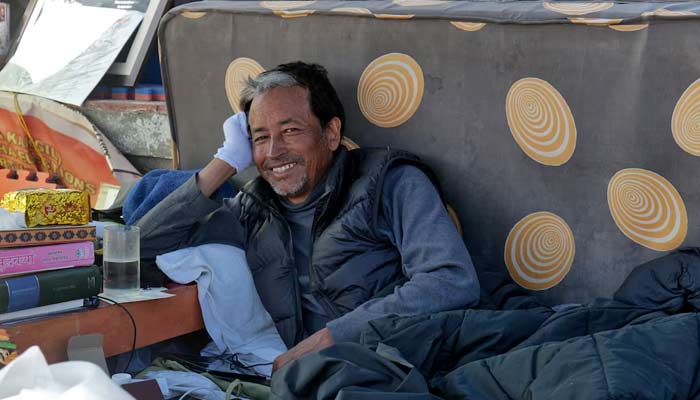
Indian police on Friday detained prominent activist Sonam Wangchuk following violent protests in the Himalayan territory of occupied Ladakh that resulted in at least five deaths, a lawyer confirmed. The demonstrations, demanding greater political autonomy for the sparsely populated, high-altitude region bordering China and Pakistan, turned deadly on Wednesday when security forces opened fire.
New Delhi quickly attributed the unrest to “provocative speeches” made by Wangchuk. The activist had been on a hunger strike, demanding either full federal statehood for occupied Ladakh or constitutional protections (known as the “Sixth Schedule”) for its tribal communities, land, and fragile environment.
Mustafa Haji, a lawyer for the Apex Body Leh—the organization spearheading the protests—told AFP that Wangchuk was “picked up” by the police from his village of Uley Tokpo on Friday. “Charges against him are not known yet,” Haji stated.
Wangchuk, 59, is an engineer by training and is widely known for pioneering water conservation projects in the Himalayas. He received the prestigious Ramon Magsaysay Award in 2018 for his environmental work and contributions to reforming local schooling in occupied Ladakh. His life and work were the alleged inspiration for a character portrayed by Bollywood star Aamir Khan in the wildly popular film “Three Idiots.”
A vocal advocate for the region’s environmental protection and tribal rights, Wangchuk was briefly detained by Delhi Police during a protest march last year. On Thursday, Indian authorities also cancelled his non-profit organization’s foreign funding licence.
Modi’s government unilaterally split occupied Ladakh from Indian Illegally Occupied Jammu and Kashmir in 2019, imposing direct rule on both. New Delhi has yet to fulfill its promise to include Ladakh in the “Sixth Schedule” of India’s constitution, which would allow its people to enact their own laws and policies.
The Indian army maintains a significant presence in occupied Ladakh, which includes disputed border areas with China. Troops from the two countries clashed there in 2020, resulting in the deaths of at least 20 Indian and four Chinese soldiers.
