

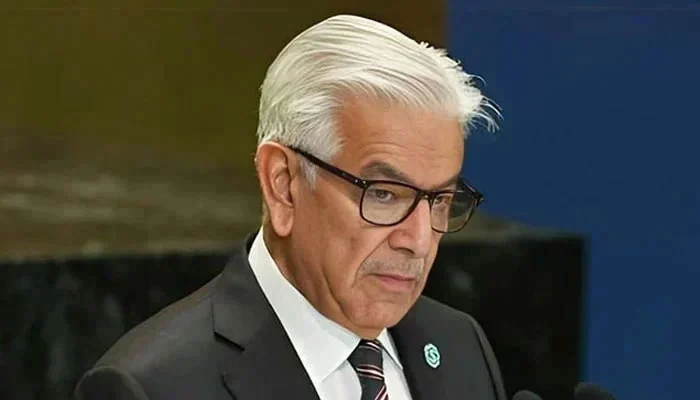
Defence Minister Khawaja Asif clarified on Friday that the United States has made no demands on Pakistan following the recent positive shift in bilateral relations. Speaking on the Geo News program “Aaj Shahzeb Khanzada Kay Sath,” Asif stated that circumstances stemming from the war have led to a “positive turn” in Pakistan-US relations.
He emphasized that Pakistan would meticulously assess any potential requests from Washington. He added, “If any demand does come, we will take a decision keeping in view our national interest.”
His statement came a day after Prime Minister Shehbaz Sharif and Chief of Army Staff (COAS) Field Marshal Asim Munir met US President Donald Trump at the Oval Office. During the meeting, the premier expressed his “deep admiration” for Trump, describing him as a “man of peace” engaged in sincere efforts to end global conflicts.
The two leaders also discussed regional security, including counter-terrorism cooperation. PM Shehbaz thanked President Trump for his public endorsement of Pakistan’s role in counter-terrorism and stressed the need to further enhance security and intelligence cooperation. Images released from the White House showed PM Shehbaz, COAS Munir, and President Trump engaged in cordial discussions. US Secretary of State Marco Rubio and Vice President JD Vance were also present.
In his speech at the 80th United Nations General Assembly today, the premier specifically praised Trump’s peace efforts after he brokered a ceasefire between Pakistan and India following a four-day fight in May. PM Shehbaz noted that Trump’s intervention helped avert a more threatening war in South Asia, stating that the consequences of a full-fledged war would have been catastrophic had he not intervened timely and decisively.
The Prime Minister also confirmed that Islamabad had nominated Trump for the Nobel Peace Prize in “recognition of Trump’s wonderful and outstanding contribution to promoting peace in our part of the world.”
US-Pakistan ties have seen a recent warming under Trump after years of Washington primarily viewing Pakistan’s rival, India, as a counter to China’s influence in Asia. Since then, Islamabad and Washington have been engaged in high-level interactions between both civil and military leadership and have also finalised a highly anticipated trade deal, reflecting the improving relations. The United States and Pakistan announced the trade deal on July 31, with a 19% tariff rate imposed by Washington, while a trade deal with India is yet to be reached.
