

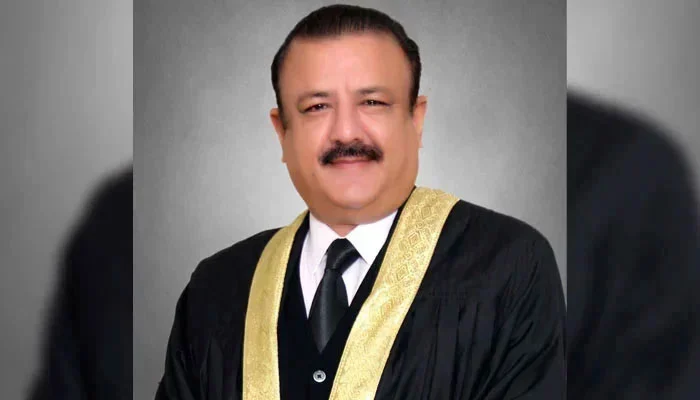
A constitutional bench of the Sindh High Court (SHC) has asserted that its September 22 order regarding the degree of Islamabad High Court (IHC) Justice Tariq Mehmood Jehangiri stands as a “judicial order” and remains valid. The court clarified that if the petitioners had any reservations about the order, the correct procedure was to challenge it before the Supreme Court of Pakistan. The bench observed that no such challenge had been lodged, even after a lapse of almost a week.
In issuing its order on identical petitions concerning the IHC judge’s degree, which were dismissed by the bench for non-prosecution amidst the counsel’s protest on Thursday, the division bench led by Justice Mohammad Karim Khan Agha rejected the counsel’s demand for the judges’ recusal on the grounds of bias, observing that the decision to recuse was a matter for a judge’s conscience.
The counsel in Justice Jehangiri’s degree case had questioned the legality of the bench’s action in assigning the matter to itself from another constitutional bench that had already scheduled the petitions for hearing on September 30. The lawyers consequently boycotted the court proceedings when the bench declined to withdraw from the case. The bench noted that both judges were of the view that no valid grounds for their recusal existed, and established legal principles dictate that a question of maintainability must be addressed first.
The SHC bench also dismissed the objections from the petitioners’ counsel that the petitions should be heard and decided by a regular SHC bench, stating that the nature of the relief sought placed them within the purview of the constitutional benches. The high court noted that the petitioners and an intervener had deliberately refused to pursue the matter, walking out during the hearing when requested to argue on the maintainability of the petitions. The SHC observed that the reasons for this were clear: they sought to demonstrate a deliberate lack of interest, which constituted a gross abuse of the court’s process.
The bench maintained that superior courts possess the inherent power to dismiss constitutional petitions for non-prosecution or default to regulate proceedings under Article 199 of the Constitution, a principle the Supreme Court has confirmed where persistent lack of diligence warrants dismissal. The high court stated it was compelled to dismiss the petitions due to non-prosecution.
Regarding the counsel’s objection to the bench’s composition, the SHC remarked that it is for the court itself to determine how to regulate its own proceedings, and it cannot be dictated to by advocates. The SHC noted that it had determined that the preliminary objections and, if necessary, the question of maintainability would be decided through a single common order. The high court reasoned that, naturally, if the objections were found to be valid, the question of maintainability might become irrelevant.
The SHC also took exception to the unruly behaviour of some counsel, observing that they began raising slogans against the judiciary, completely disrupting the court’s decorum. It noted that such conduct was highly unbecoming and unexpected from senior members of the legal profession and prima facie amounted to contempt of court. The SHC, however, decided to refrain from issuing any notices out of indulgence and by showing maximum judicial restraint, but warned that the counsel must maintain court decorum in the future.
The high court observed that it had offered all petitioners’ counsel an opportunity to be heard on the question of maintainability; however, one of the counsel deliberately chose not to take this opportunity, instead walking out of the courtroom while causing a disturbance.
The SHC also directed the court registrar to immediately preserve all CCTV and any audio recordings from September 25, both inside and outside the courtroom. The high court affirmed that it is the court’s prerogative to regulate its proceedings, and it cannot be held hostage to the advocates’ whims or wishes regarding the manner in which petitions are heard. The bench noted that Justice Jehangiri addressed the court with dignity and patience, though not on the point of any petition or listed application, which were accordingly dismissed for non-prosecution as he also left the courtroom despite being given an opportunity to be heard on any petition or listed application.
The petitioners, including the Karachi Bar Association and others, had challenged the decision of the unfair means committee of the University of Karachi on August 17, 2024, which had resulted in the cancellation of Justice Jehangiri’s degree. The petitioners’ counsel had previously argued that under the university’s relevant clauses, all punishments under Regulation 14 must be awarded by the syndicate on the recommendation of the unfair means committee, and the latter could hold an inquiry itself or authorise one or more of its members to do so.
