

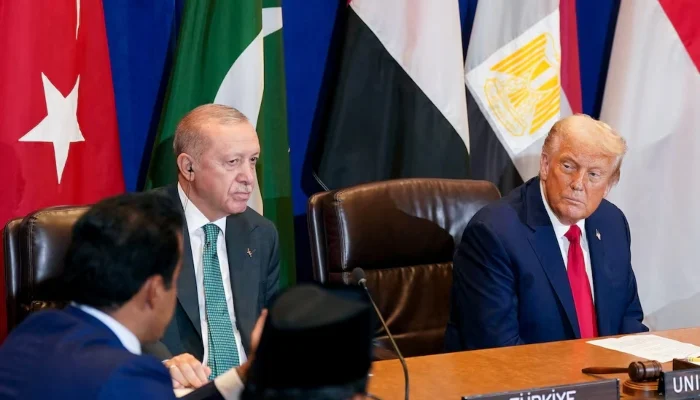
Turkish President Tayyip Erdogan will be hosted by US President Donald Trump at the White House on Thursday. The Turkish leader hopes to leverage what are the warmest bilateral ties in years to convince Washington to lift sanctions and allow Turkey to purchase F-35 fighter jets.
Erdogan’s first visit to the White House in about six years comes as Ankara is keen to take advantage of a US administration that’s eager to make deals in return for big-ticket arms and trade agreements. The administration of former president Joe Biden kept Turkey at arm’s length, partly due to what it saw as the fellow NATO member’s close ties with Russia. Under Trump, who views Moscow more favorably and has closer personal ties with Erdogan, Ankara is hoping for a better relationship.
Trump and Erdogan had a complex relationship during the Republican president’s first term. Since his return to the White House, however, their interests have aligned on Syria—the source of the biggest bilateral strain in the past—where the US and Turkey now both strongly support the central government. They remain sharply at odds over US ally Israel’s attacks on Gaza, which Ankara calls a genocide—a potential wild card in what are otherwise expected to be friendly and transactional talks in the Oval Office.
In his UN address on Tuesday, Erdogan, who has led Turkey for 22 years, stated that “anyone who fails to speak out and take a stand against the barbarity in Gaza shares responsibility for this atrocity.” US Secretary of State Marco Rubio later told Fox News that world leaders, including Erdogan, could “say what they want to say, but at the end of the day, when they want something done, they want to come to the White House.”
US Sanctions Block F-35 Sales
This shift in mood has renewed Turkish hopes that Trump and Erdogan, who have exchanged mutual praise, can find a way around the US sanctions imposed by Trump himself in 2020. Those sanctions were a result of Turkey’s acquisition of Russian S-400 missile defense systems. Overcoming the sanctions could, in turn, pave the way for Ankara to buy Lockheed Martin’s advanced F-35 fighter jets, for which it was both a buyer and a manufacturer until it was barred over the S-400s.
“Despite expected resistance from the US Congress, a green light for Turkish acquisition of F-35s is not inconceivable, provided the political will is there on both sides and diplomats are allowed to hammer out a framework that addresses all the known issues,” said Timur Soylemez, a former Turkish ambassador with experience in Turkey-US relations.
Ahead of the meeting, Trump said he expected F-35 talks “to conclude positively.” Erdogan has said that the defense industry, including the topic of F-35s and ongoing negotiations over 40 F-16 jets Ankara also wants, would be a focus of the meeting, along with regional wars, energy, and trade.
A US official said that Washington had recently drafted a statement of intent—a document used to facilitate talks—for several sales to Turkey, including the new F-16s that would bolster its existing fleet. The official added that Turkey asked for advanced equipment and modifications on the F-16s in their order, making the jets cost more than a standard F-35. However, F-35s were omitted from the draft statement because the US cannot legally sell them while Turkey has the S-400s, the person added. Turkish government officials did not immediately comment on the F-16 costs.
Boeing Aircraft Deal Also on the Agenda
Turkey, NATO’s second-largest army, wants to ramp up its air power to counter what it sees as growing threats in the Middle East, Eastern Mediterranean, and the Black Sea, where it borders Russia and Ukraine. In addition to the F-16s and F-35s, it also wants to acquire 40 Eurofighter Typhoons—which has irked regional US allies Israel and Greece.
At the meeting, Trump is expected to highlight a Turkish agreement to buy more than 200 Boeing aircraft, for which Turkish Airlines is currently negotiating. A US official told Reuters that the talks included 787 and 737 jetliners, and about $10 billion in GE aircraft engines.
