

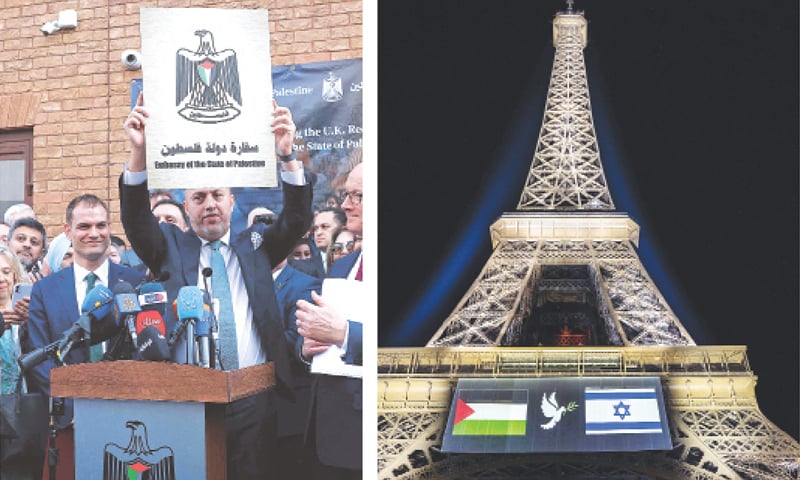
At a high-level conference on Monday, France and Monaco formally recognized the State of Palestine. French President Emmanuel Macron stated that the move was necessary to preserve the possibility of a two-state solution, with an embassy opening contingent upon a ceasefire, reforms, and the release of all remaining prisoners in Gaza. Other European nations, including Andorra, Belgium, Luxembourg, and San Marino, were also expected to recognize Palestine. This follows similar actions by Australia, Britain, Canada, Portugal, and Malta.
Pakistan and the Two-State Solution
Pakistan, represented by Foreign Minister Ishaq Dar, affirmed its active participation in the conference. The country, which was among the first to recognize Palestine’s independence in 1988, urged other nations to do the same. This stance aligns with Pakistan’s long-standing policy of supporting a two-state solution based on the pre-1967 borders with East Jerusalem as the capital.
International Responses and Trump’s Opposition
The recent wave of recognitions represents a significant shift in policy for many Western powers. The UK, historically instrumental in the creation of Israel through the 1917 Balfour Declaration, also opened a Palestinian embassy in London. However, this momentum has faced strong opposition from U.S. President Donald Trump, who has been clear that he disagrees with these decisions. He argues that recognizing Palestine rewards Hamas and has publicly voiced this opinion. Trump is expected to address the UN General Assembly and meet with leaders from eight Muslim-majority countries to discuss the situation in Gaza.
