

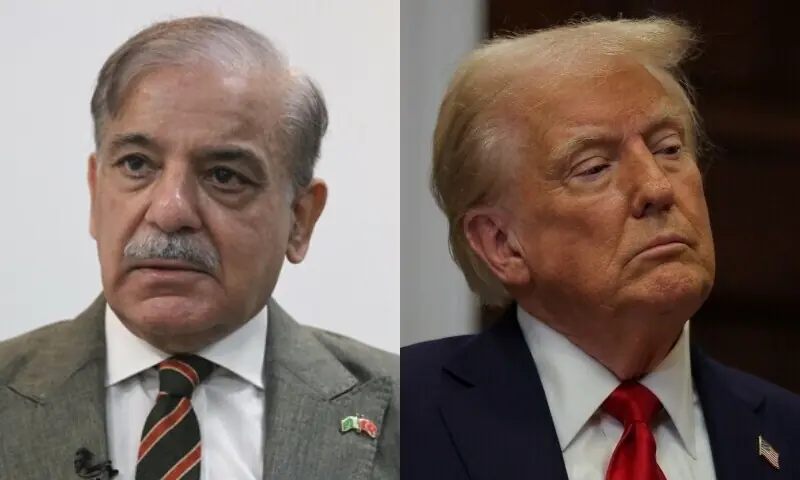
Prime Minister Shehbaz Sharif is expected to meet with President Donald Trump in Washington, with the meeting scheduled for around 1:30 am (PST) on Friday. Army Chief Field Marshal Asim Munir is expected to accompany the premier, while US Secretary of State Marco Rubio will join President Trump.
A Trump administration official confirmed the meeting to Reuters, which comes weeks after the two countries agreed to a trade deal. According to Radio Pakistan, the two leaders are “expected to discuss matters of mutual interest as well as the regional and global situation.”
This development occurs as the premier travels to the US for the 80th session of the United Nations General Assembly (UNGA) in New York. During his tour, PM Shehbaz has attended UNGA sessions, a key multilateral summit of the Muslim bloc, and side meetings with the heads of international financial institutions in New York.
Following the meeting with Trump, the premier is expected to return to New York for his address to the UNGA on Friday.
During a media briefing in New York, a senior State Department official told Dawn that ties between Washington and Islamabad were “gradually warming up” during Trump’s second term.
For years, the United States had viewed India as a counterweight to China’s growing influence in Asia, while Pakistan was seen as a close Chinese ally.
Since Trump returned to office in January 2025, US relations with India have been strained due to visa hurdles for Indians, steep tariffs Washington has imposed on Indian goods, and the president’s repeated claim that he personally brokered an India-Pakistan ceasefire in May.
The senior official emphasized that US relations with Pakistan were not linked to its partnership with India.
“We have an independent relationship with Pakistan,” he said, citing recent American investments of hundreds of millions of dollars in Pakistan’s mineral sector and continued US interest in petroleum exploration.
The official added that Washington was still reviewing the recently concluded defense deal between Pakistan and Saudi Arabia.
On July 31, the two countries announced a trade agreement under which the US imposed a 19% tariff on Pakistani goods. Trump has yet to finalize a similar deal with India. Analysts note that in response to tensions with Washington, New Delhi has begun recalibrating its ties with China as a hedge.
Earlier this year, Trump welcomed Field Marshal Munir to the White House—the first time a US president hosted a Pakistani military leader without senior civilian officials present. Munir is widely regarded as the most powerful figure in the country, and his reception at the Oval Office highlighted the military’s central role in bilateral relations.
When asked about Pakistan, a senior State Department official said, “We’re working through a number of issues when it comes to counterterrorism, when it comes to economic and trade ties.”
“And so the president remains focused on advancing US interests in the region, that includes through engaging with Pakistan and their government leaders.”
Regarding India, the official stated that Trump believes in being frank about frustrations in the relationship but still considers it strong. Washington, he added, continues to view New Delhi as “a good friend and partner” whose ties with the US will “define the 21st century.”
Islamabad has publicly backed Trump for the Nobel Peace Prize for his efforts to ease tensions with India, even while condemning Israeli bombardments in Gaza, Qatar, and Iran.
Prime Minister Sharif also joined Trump on Tuesday in a meeting with leaders of several Muslim-majority countries, where the US president discussed Israel’s assault on Gaza and shared American peace proposals on the sidelines of the UN General Assembly.
PM Shehbaz meets Bangladesh’s Yunus
According to state broadcaster Radio Pakistan, PM Shehbaz also met with Bangladesh’s chief adviser, Muhammad Yunus, in New York today.
The report stated that the premier reaffirmed Pakistan’s commitment to strengthening “constructive and forward-looking ties” with Bangladesh, based on mutual respect, trust, and shared aspirations for regional peace and prosperity.
The two leaders reviewed the state of Pakistan-Bangladesh bilateral relations, discussing ways to enhance cooperation in areas including trade, regional connectivity, and people-to-people exchanges.
For his part, Yunus appreciated Pakistan’s initiative to deepen engagement and emphasized the importance of increasing bilateral trade and cultural links.
