

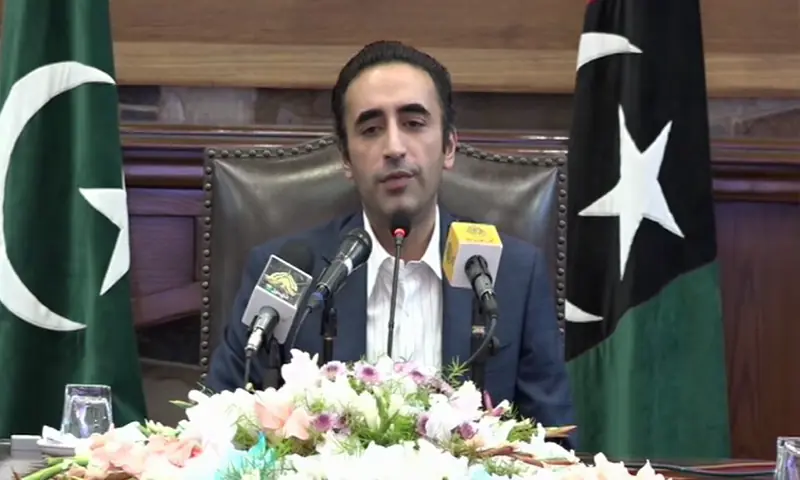
Bilawal Bhutto Zardari’s statement came amid a heightened verbal conflict between coalition partners PML-N and PPP. The dispute intensified on Wednesday after the former questioned the transparency of the BISP, while the latter accused its senior partner of an “irresponsible attitude” for refusing to use the program’s data to compensate flood-affected individuals in Punjab.
BISP is a major national welfare program in Pakistan that offers financial aid to poor and vulnerable families, with a special focus on women.
Speaking at a press conference in Karachi, Bilawal stated: “The country’s agricultural sector was already in a difficult position, but after the floods, it has been severely impacted. Our national food security may also be at risk.”
He added, “I had appealed to the federal government to declare a climate and agriculture emergency to address the losses caused by the floods.” He also mentioned that he had called for the power bills of farmers in affected districts to be waived.
He praised the federal government and Prime Minister Shehbaz Sharif for following through on his requests.
Regarding the Sindh government, he said he had discussed with Sindh Chief Minister Murad Ali Shah ways to support small farmers and landowners.
He announced that through the Benazir Hari Card, the provincial government would assist small farmers with one to 25 acres of land. He added that the Sindh government would also provide farmers with fertilizer.
“Our goal is to support the wheat crop so we don’t need to import wheat,” he said.
“If the provincial and federal governments take timely action, we can not only mitigate the losses from this flood but also avoid a heavy import bill. It is better to spend our resources on our own farmers and agricultural sector so that Pakistan’s economy can reach a position where we export instead of importing.”
Bilawal emphasized that the floods’ effects were still ongoing. He noted that while low-lying areas of Sindh were impacted, “the scale of loss in Punjab, especially southern Punjab, is historic.”
“While it’s very important to consider what you will do in the future, the most crucial thing is what you are doing today,” he said. He added that the support provided by the provincial government would be amplified if BISP were used to reach areas still submerged.
“A natural calamity is not the responsibility of a single province; across the world, the federal government takes the lead. It is also the federal government’s responsibility to deliver relief to affected people through BISP,” he said.
He mentioned that while Punjab had sustained the most damage, it should not be forgotten that Gilgit-Baltistan and Khyber Pakhtunkhwa had also suffered.
“So BISP is the only way the federal government can provide immediate relief to the affected people. This has been the standard practice,” he said, noting that the federal government had done the same in the past and during the Covid-19 pandemic.
“If we don’t do this today, I must ask: what is the fault of the people of South Punjab when they face such devastating floods, their homes are destroyed, and they are forced to live on the road?” he said, urging the federal government to “review its policy.”
He further stated that the federal government should have sought international help from the beginning.
“When the floods began, the federal government should not have waited for any provincial help. It should have issued an international appeal immediately. I am not criticizing […] but if you were spending 100 rupees, you could have spent 200; if you were helping 100 people, you could have helped 200,” he said.
“By talking to the international community and seeking a review of International Monetary Fund (IMF) restrictions, your hand would have been stronger had you made a timely global appeal as you did before. This time it should have happened, and it did not.”
