

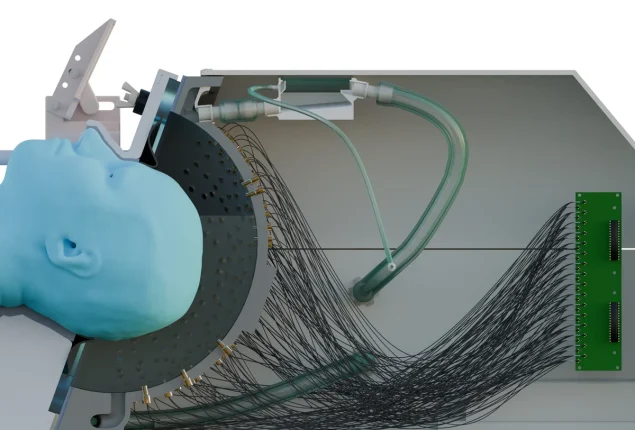
As humanity continues to achieve remarkable milestones like reaching the Moon and exploring space, scientists are now focusing on a more intricate frontier: the human brain. In a groundbreaking development, researchers in the UK have introduced a non-invasive helmet that can observe and influence brain activity without the need for surgery.
This state-of-the-art device could revolutionize the treatment of neurological and psychiatric conditions such as Parkinson’s disease and depression. Designed with a focus on comfort and precision, the helmet represents a significant advancement in integrating cutting-edge technology with healthcare.
Developed by experts at University College London and the University of Oxford, the helmet-shaped device uses highly focused ultrasound pulses to stimulate specific, deep-seated areas within the brain. Unlike older methods, which often affected broader or unintended regions, this technology can target areas nearly 1,000 times smaller, offering unprecedented accuracy.
Neurophysiologist Dr. Charlotte Stagg, a lead researcher on the project, stated: “This is the first time we’ve managed to reach such deep brain targets with this level of precision using only external equipment. It opens doors to non-invasive treatment options we couldn’t have imagined before.”
The helmet works by emitting ultrasound waves from 256 small sources embedded within the device. These waves converge at a chosen point in the brain to either increase or suppress neuronal activity. In early trials involving human volunteers, the team successfully activated and deactivated a region involved in visual processing, with effects lasting up to 40 minutes post-stimulation.
While further testing is planned, these initial findings signal the potential for a new, non-surgical approach to managing complex brain disorders—a step that could transform modern neuroscience and mental health treatment.
