

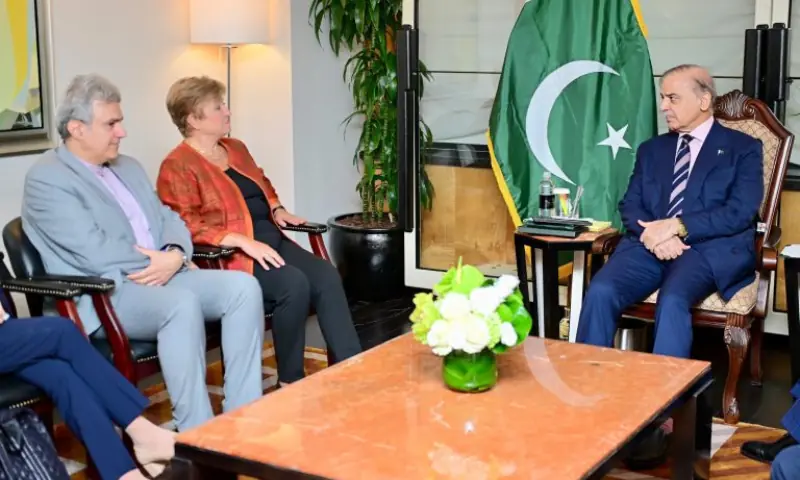
In a meeting on the sidelines of the 80th Session of the UN General Assembly in New York, Pakistan’s Prime Minister met with IMF Managing Director Kristalina Georgieva. The PM highlighted the country’s progress in meeting the targets of its IMF program. A report from Topline Securities suggests that Pakistan is on track to meet all seven Quantitative Performance Criteria (QPC) ahead of the September 25 review for its $7 billion Extended Fund Facility (EFF). This review will evaluate Pakistan’s performance for the March–June 2025 quarter.
Following the meeting, a statement from the Press Information Department (PID) quoted the prime minister as saying that while Pakistan was making steady progress, the impact of the recent floods on the economy must be considered during the IMF’s review. The country has been hit by massive floods that have caused billions in damages and strained food supplies and exports.
The government had been optimistic about achieving a 4.2% growth rate in 2026, driven by a rebound in agriculture and manufacturing, after stabilizing the economy with the IMF bailout. However, record monsoon rains since late June, amplified by dam releases from India, have submerged vast areas of Punjab and Sindh. Officials and analysts are concerned that the economic blow could be more severe than the 2022 floods due to dual shocks to both agricultural and industrial sectors.
According to the agricultural monitoring initiative GEOGLAM, at least 220,000 hectares of rice fields were flooded between August 1 and September 16. The Provincial Disaster Management Authority in Punjab reported that 1.8 million acres of farmland have been submerged.
According to the PID statement, Georgieva expressed her sympathy for the flood victims and noted the importance of damage assessment for setting recovery priorities. She commended the Prime Minister’s commitment to sound macroeconomic policies and reaffirmed the IMF’s continued support for Pakistan’s economic reforms.
Separately, the Prime Minister also met with World Bank Group President Ajay Banga and praised the bank’s support. He briefed Banga on the government’s comprehensive reform agenda, which includes resource mobilization, energy sector reforms, and privatization. The PM also commended the new Country Partnership Framework (CPF), which provides $40 billion for Pakistan. The World Bank President praised Pakistan’s reform measures and reaffirmed the bank’s readiness to support long-term climate resilience initiatives under the new CPF.
