

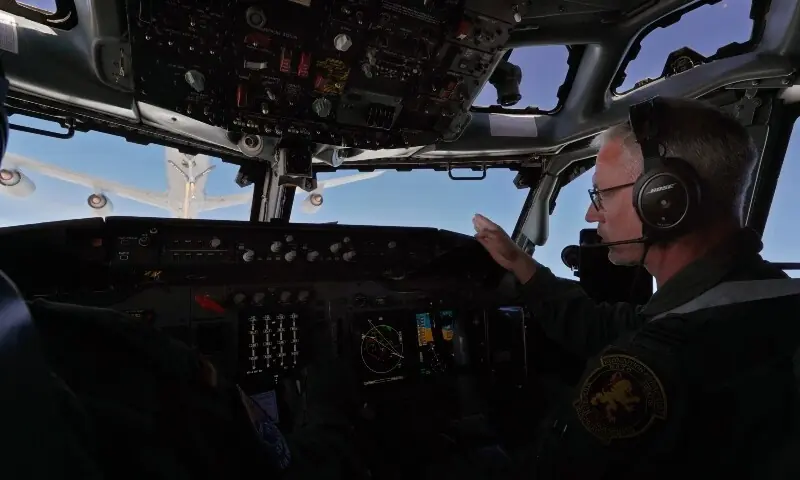
In response to a recent escalation of incidents, including two Russian fighters violating Estonian airspace for 12 minutes, NATO has launched a new mission, Eastern Sentry, to bolster its eastern flank. The goal is to provide an early warning and prevent the war in Ukraine from spilling over into the alliance’s territory. This decision follows a watershed incident in Poland where NATO jets shot down Russian drones.
‘Eyes in the Sky’
As part of the mission, one of NATO’s 14 centrally-owned AWACS (Airborne Early Warning and Control) aircraft conducted an eight-hour flight from a base in Germany to circle over eastern Poland. Dubbed NATO’s “eyes in the sky,” these planes are equipped with a massive radar with a range of some 500 kilometers. This allows the crew to peer into hostile territory like Belarus and Russia’s Kaliningrad region and spot objects as small as a large bird. Lieutenant Colonel Mike Belizaire, a German officer, stated that their mission is to provide an early warning, giving commanders more time to decide how to respond to a threat. A surveillance operator, Aaron Peace of the US Air Force, added that he can assess a potential threat in under 30 seconds.
The Rising Threat of Drones
While the AWACS planes provide a clear picture of the air activity, the prevalence of low-cost drones in the Ukraine war presents a new challenge. “The AWACS was built to track planes that fly higher and faster, so these smaller, slower-moving objects definitely pose a bigger challenge to track and identify,” Peace said. A NATO official, speaking anonymously, acknowledged that while they can monitor the drones, they don’t necessarily have the right equipment to counter them effectively. In Poland, they had to use their most modern F-35 jets and expensive missiles to take out the drones, which the official admitted is not the ideal way to defeat them. The use of a costly missile from a very expensive plane to destroy a low-cost drone has raised questions about NATO’s readiness for this new form of warfare.
