

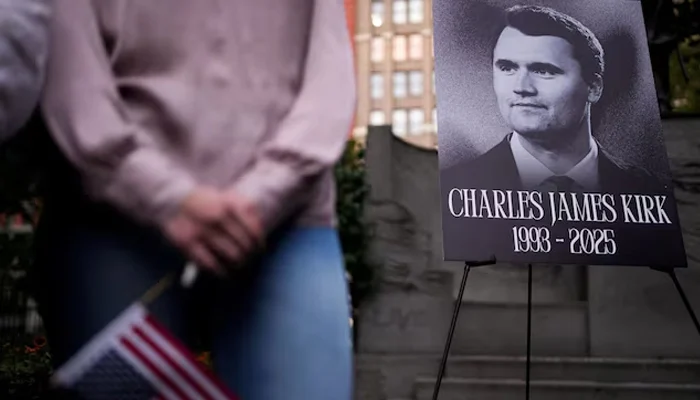
In the U.S., the First Amendment, which guarantees freedom of speech, is at the heart of a heated national debate following the death of right-wing activist Charlie Kirk. On Thursday, top Democrats accused President Donald Trump of undermining this constitutional right. This came after Trump publicly supported ABC’s decision to suspend talk show host Jimmy Kimmel, who had accused political conservatives of exploiting Kirk’s death for political gain.
The American Civil Liberties Union (ACLU) has likened the Trump administration’s actions to the Red Scare of the 1940s and 50s under Senator Joseph McCarthy. Christopher Anders, a director at the ACLU, said, “This is beyond McCarthyism. Trump officials are repeatedly abusing their power to stop ideas they don’t like, deciding who can speak, write, and even joke.”
What is the First Amendment?
The First Amendment is part of the Bill of Rights, which was ratified in 1791. It states: “Congress shall make no law respecting an establishment of religion, or prohibiting the free exercise thereof; or abridging the freedom of speech, or of the press; or the right of the people peaceably to assemble.”
According to David Super, a law professor at Georgetown University, the amendment defines America’s national identity. He explained that despite the nation’s 340 million people coming from diverse backgrounds, they are united by a shared belief in open discussion and the principle that the government cannot silence them. Similarly, Eugene Volokh, a law professor at UCLA, noted that the First Amendment protects even “morally repulsive” speech. However, he also pointed out that attempts to suppress dissenting voices have a long history in the U.S.
Historical Attempts to Curb Free Speech
Throughout U.S. history, various laws and policies have tried to limit free speech, including:
- The Sedition Act of 1798: This law, signed by President John Adams, banned “any false, scandalous and malicious writing or writings against the government of the United States.”
- World War I: The expression of pacifist views was prohibited.
- The 1920s to 1950s: People who supported communist ideals faced severe consequences.
- The 1960s: Officials in some southern states attempted to silence the civil rights movement.
The “Cancel Culture” Debate
A central theme of Trump’s political movement has been to oppose “cancel culture,” which he defines as a practice used by progressives to silence conservative voices. However, Democrats have accused him of the same behavior. Former President Barack Obama posted on X that after years of complaining about cancel culture, the current administration has “taken it to a new and dangerous level.”
Conservative Pushback and Contradictions
The debate has also created some contradictions within the conservative movement. Attorney General Pam Bondi faced criticism from fellow conservatives when she said the Justice Department would go after “hate speech” related to Kirk’s death. Republican Senator Ted Cruz quickly corrected her, stating that the Constitution “absolutely protects hate speech,” leading Bondi to clarify that she was referring to “threats of violence.”
Additionally, some on the far right have criticized a decree signed by Trump in August that makes burning the American flag a federal crime punishable by up to a year in prison. The Supreme Court had previously ruled in 1989 that flag burning is a form of free speech protected by the First Amendment. Conservative radio host Jesse Kelly captured this sentiment on X, writing that while he would never harm the flag, the president’s decree “has me as close as I’ll ever be to lighting one on fire.”
