

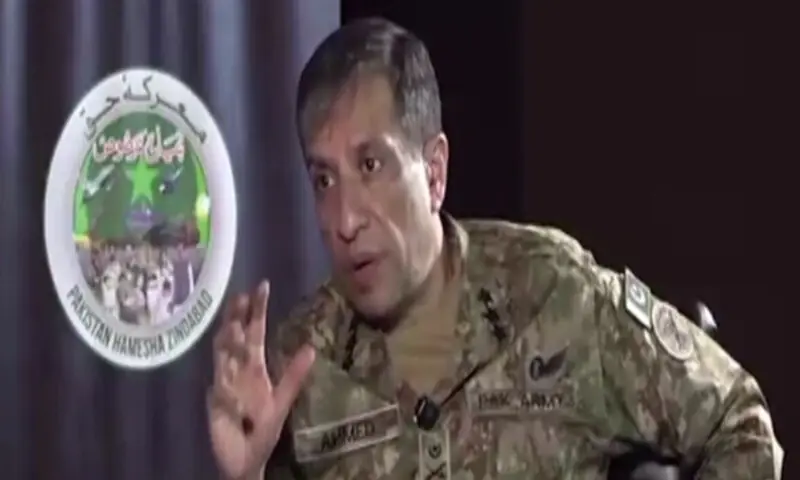
In an interview aired on Pakistani television channels on Friday, the DG ISPR shared his views. According to the channels, the interview was reportedly given to a German media outlet.
During the interview, the military spokesperson was asked about Army Chief Asim Munir’s visits to the US and whether they had contributed to “warming up” relations between Islamabad and Washington.
In his response, Lt-Gen Chaudhry praised the US and President Trump’s role in mediating a ceasefire between India and Pakistan in May following a four-day escalation. He said, “Over a period of time, we have been able to enhance and amplify our convergences (with the US) and deftly managed the divergences.”
“There are areas where a lot can be done, there are areas where a lot of engagement can be done,” he said, adding that “Pakistan views its relationship with the US as very important.”
“We don’t think that these relationships have anything to do—or that it’s an either-or with other countries.” At this point, the interviewer interjected to mention China, and following a cut in the video, the DG ISPR continued, “We, at the same time, have very constructive and strategic relationships with China and other countries.”
He stated there is significant “scope” for collaboration between the US and Pakistan on counterterrorism. He also expressed satisfaction with the United States’ recent designation of the Majeed Brigade as a terrorist organization. Pakistan has officially proscribed the Majeed Brigade—the Balochistan Liberation Army’s suicide squad—as a terrorist entity since July 18, 2024.
Regarding Pakistan’s concerns about weapons systems left behind by the US after its withdrawal from Afghanistan, the DG ISPR cited the retrieval of US-made weapons from terrorists involved in the Mianwali airbase attack on November 4, 2023, as evidence. He said, “We share all this data with the Americans,” adding that “the amount of weapons left behind by the US is huge.” Citing a report prepared by the Special Inspector General for Afghanistan Reconstruction (SIGAR), Lt-Gen Chaudhry said that “after the withdrawal of the United States and NATO forces, more than $7.2 billion worth of US equipment has been left.”
On the issue of strained relations with India, the DG ISPR referred to the May escalation, noting that “on May 10, the fire actually ceased—it’s the cease of fire that happened, [but] the conflict endures.” He continued, “Whether it is the Kashmir issue, whether it is state-sponsored terrorism of India, whether it is the rising extremism of Hindutva mentality, rationality that has gripped India—”
Stating Pakistan’s position, he said, “Pakistan believes that the issues need a resolution,” and called for international players to intervene. “Especially players like the USA, they must intervene,” he said. He further stated: “We have no doubt in our minds in Pakistan that each and every incident of terrorism that happens in Pakistan—behind that is Indian support and its abetment.” He highlighted that given the threat Pakistan faces, “any sane mind can understand this cannot go on without external support.”
The DG ISPR alleged that “the base of operation that the Indians use is Afghanistan; the whole of terrorism that is being done is executed by the Indians over there.” He claimed that “Indians have a playbook of using terror as a tool of state,” and that their “main tools” at the moment are the terrorist outfits Tehreek-e-Taliban Pakistan (TTP) and BLA.
When asked about an insurgency in the country, the DG ISPR denied its existence. “There is no insurgency in Pakistan; the correct term is terrorist,” he said. Asked if the grievances of the people in Balochistan are properly addressed, he claimed that only a fraction of Balochistan’s total population actually lives in the province. “Before talking about the issue, it is important to see how many Baloch are we talking about,” he said. On the issue of missing persons in Balochistan, he claimed that “half of these missing persons are part of BLA.” He added that several terrorists killed in Balochistan were also on the list of missing persons, claiming there were more missing persons in Sindh and Punjab than in Balochistan.
