

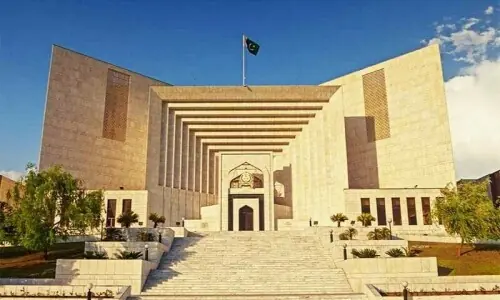
A special bench of the Islamabad High Court (IHC), headed by Justice Aminuddin Khan, heard multiple petitions challenging the constitutional validity of the amended Section 4C of the Income Tax Ordinance (ITO), 2001, applicable to the tax year 2023.
Senior counsel for the Federal Board of Revenue (FBR), Hafiz Ehsaan Ahmad Khokhar, argued that the present case did not involve any question of the National Assembly’s legislative competence. He informed the court that the federal government would submit a written response within a few days.
Previously, on April 4, 2024, a division bench of the IHC had directed one of the respondents to continue paying their tax liability under Section 4C.
The super tax, introduced in 2015, applies to wealthy individuals, associations of persons, and companies earning above Rs500 million. It was implemented to fund the rehabilitation of temporarily displaced persons.
Khokhar defended the constitutionality of Sections 4B and 4C of the ITO, 2001, stressing that under Article 77, parliament has the exclusive authority to levy taxes. He noted that Section 4B, which had already been upheld by various high courts, was a lawful exercise of fiscal power.
Addressing Section 4C, introduced in 2022, he argued that high courts had erred by “reconstructing the statutory scheme,” which he termed “judicial legislation.” He emphasized that under Article 199, courts can only strike down laws that clearly violate fundamental rights, not redesign tax schemes.
Dismissing the claim of double taxation, Khokhar called the argument “wholly misconceived,” explaining that the super tax is not a separate levy but an additional component of income tax on high-income earners, akin to a surcharge or advance tax.
