

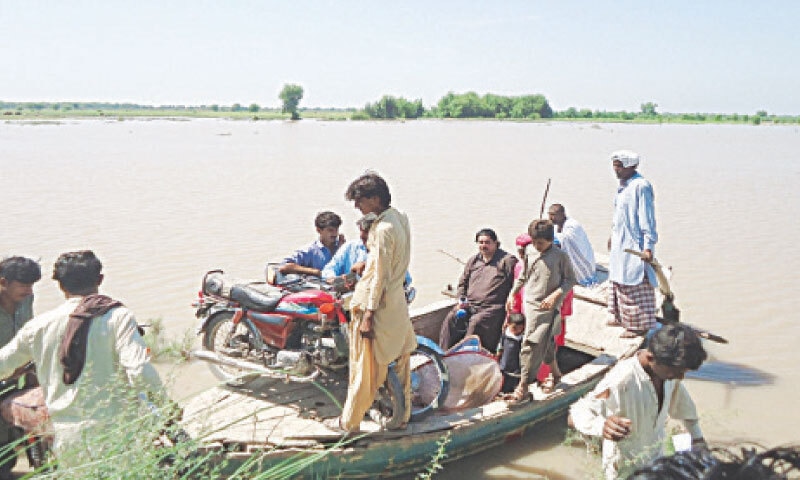
Entire settlements of Ramzan Mallah, Usman Khaskheli, and Haji Shahdad Khaskheli have been encircled by water, cutting off their road access to nearby towns. Villagers are now using boats to receive food and other essentials.
As the lake swells with Indus waters, reverse flow has begun, inundating vast tracts of the riverine belt. Last week, in a desperate attempt to prevent damage from the rising floodwaters, the Ghar Marhu canal, which irrigated hundreds of thousands of acres through Udero Lal Barrage on the river, was blocked near the GBU dyke.
Questions Over Preparedness On-the-ground preparedness, however, remains questionable. Near Isa Khaskheli village, the irrigation department has set up only a makeshift hut staffed by a few junior employees. A bulldozer stationed there is idle due to a lack of fuel. During a visit by journalists, the dyke was found abandoned, with no senior irrigation officials in sight.
The bulldozer’s operator said, “The bulldozer has just been parked here for show. It has no diesel,” adding that repeated appeals for fuel had been ignored by the concerned officers.
For villagers in Isa Khaskheli, Basar Khaskheli, Ali Muhammad Khaskheli, and Gheel Mori town, anxiety grows daily. With their homes underwater and escape routes cut off, they fear the dyke could collapse without urgent intervention. Local communities are demanding immediate action against negligent irrigation officials and the deployment of trained staff and resources at the Baghar Ochto dyke to prevent what they warn could become a humanitarian disaster.
Dyke Reinforcement Underway in Larkana In Larkana, officials are focused on taking all possible measures to ensure the flood safely passes under Sukkur Barrage and flows to the sea with minimal or no damage.
Presently, the Moria Loop Bund, New/Old Abad Loop Bund, and Hakra Loop Bund, managed by the Northern Dadu division, have been declared highly sensitive. Irrigation officials are vigilant and busy strengthening the existing structures.
Reports from Naudero on Saturday suggest that the Indus is continuously rising at Burira Ferry point, forcing villagers in the riverine areas to move to the dykes. They plan to return to their homes as soon as the water recedes.
A few families who have taken shelter on the Larkana-Sehwan dyke near Dodo Sanhari village complained about a lack of assistance from the district government. At the Larkana-Khairpur bridge alongside the ‘Palija bund,’ floodwater is approaching the dyke, where the irrigation department has set up temporary huts with staff to monitor the situation. A large number of dumpers and trucks loaded with stones are being unloaded at the Moria Loop dyke, where the river is striking with full force.
MPA Mir Nadir Magsi stated on Friday that the New/Old Abad dyke is highly sensitive. Northern Dadu Division’s superintendent engineer Jamil Sangi, assistant engineer Riaz Abbasi, and sub-engineer Nadeem Jaffery told journalists that work to strengthen the dyke is ongoing. Mr. Sangi said this dyke is located four kilometers upstream near the Larkana-Khairpur bridge structure and is part of the Larkana-Sehwan dyke.
The river has created an island at this point and shifted its main current about one mile away from the main dyke, while stagnant water remains there. The irrigation officials said the main current could shift at any moment, as it all depends on the river’s behavior.
Sources in the irrigation department disclosed that the Japan International Cooperation Agency (JICA) had committed to strengthening the New/Old Abad dyke two years ago, but the work has yet to start as it awaits the completion of studies required by JICA’s criteria. The sources added that the dyke is not in good shape and a team of experts from JICA is expected to arrive on Monday to visit the site with concerned irrigation officials.
Almost all low-lying areas near the dyke are filled with floodwater, but surprisingly, the residents are still reluctant to leave their houses and move to the dyke or a safer place.
At the Hakra Loop dyke, six kilometers from Mohenjo Daro, irrigation staff are stationed in temporary huts. Work on the apron and stone pitching is underway from 13/0 miles to 22/2 miles, where floodwater is impacting the dyke. The irrigation staff there said that the 16/1 mile portion of the Hakra dyke is currently at risk.
There are five spurs to protect the Hakra Loop dyke; however, residents of the riverine area were seen trying to reach the dyke by wading through the stagnant water that has inundated their land, crops, and houses.
