

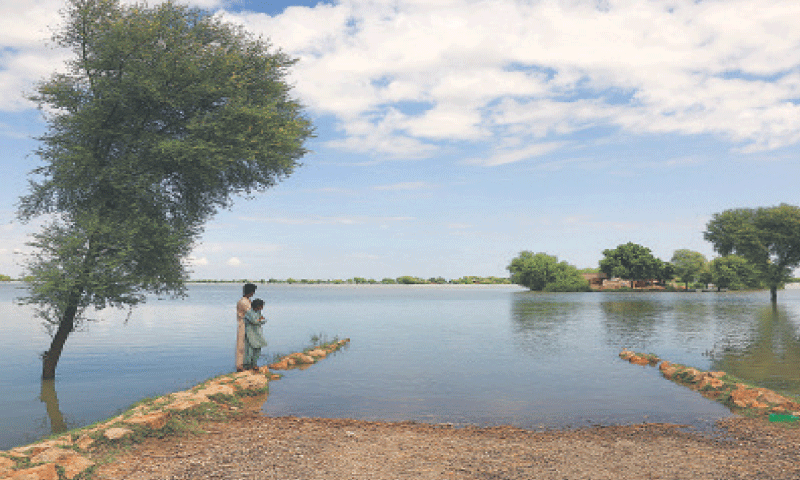
Central and south Punjab are facing ongoing evacuation efforts due to exceptionally high flood levels between the Panjnad confluence of the Chenab, Ravi, and Sutlej rivers and the Guddu Barrage in Sindh. This has created a severe humanitarian crisis, submerging low-lying areas, displacing large populations, and destroying hundreds of acres of crops.
The overflowing Indus River has also flooded parts of Sindh, with widespread displacement in riverine areas of Dadu and Larkana. Residents in these flood-hit regions are also dealing with extensive power and mobile service outages, leaving them cut off from authorities and family members while being surrounded by rising waters.
According to Punjab Relief Commissioner Nabil Javaid, 97 lives have been lost in what he called the “biggest flood in history” for the province. He reported that 2.45 million people from 4,500 villages along the Ravi, Sutlej, and Chenab rivers have been affected, and 1.9 million cattle have been moved to safe locations.
The Flood Forecasting Division (FFD) has issued a warning of a very high flood at Head Panjnad, Sidhnai, and Ganda Singh Wala, while high flood levels persist at Head Sulemanki, Head Islam, and Mailsi Syphon. FFD data from 1 a.m. Saturday showed a flow of 651,572 cusecs at Panjnad Headworks, with outflows at Guddu Barrage remaining steady at 537,392 cusecs.
On Friday, a total of 19 controlled breaches were made to reduce the flood threat to Jalalpur and Alipur, while a damaged dyke in Shujabad continued to be repaired. In Shujabad, a dyke collapse at Mouza Dhundwala flooded several villages and sent water toward the city. Officials are working to reinforce the Bakhto Wah canal dyke to protect the town, but several villages are already submerged.
Punjab Senior Minister Marriyum Aurangzeb visited the breach site and instructed officials to seal it. Unfortunately, three workers sent to repair the breach were swept away by the floodwaters. While two were rescued, their third colleague could not be found and is feared dead.
Authorities also made controlled breaches on Uch Sharif Road to divert water away from Jalalpur city. In Alipur, the administration breached Seetpur Road at 18 different locations, which submerged several villages and left thousands stranded on rooftops.
Marriyum Aurangzeb also visited Alipur and declared the tehsil a “calamity-hit area.” Residents told her that six members of one family were missing after a rescue boat capsized, and that many people were still stranded on rooftops without available boats for evacuation. To help, the government deployed drones to deliver food and supplies to those stranded on rooftops.
Rescue spokesperson Farooq Ahmad stated that 18,130 people have been rescued from Jalalpur Pirwala, 11,700 from Liaqatpur, and 6,400 from Alipur. Over the last 24 hours, a total of 19,946 people were rescued from flood-affected areas across Punjab.
In Sindh, floods have inundated parts of Dadu after the Indus River overflowed near the Dadu-Moro Bridge, submerging over 30 villages and displacing a large population. The rising waters have also led to outbreaks of waterborne and other infectious diseases. The Health Department, People’s Primary Healthcare Initiative, and Rescue 1122 have set up medical camps and deployed mobile ambulances to provide urgent care.
In a separate statement, Prime Minister Shehbaz Sharif praised the chief ministers of all four provinces, along with the governments of GB and AJK, for their prompt and effective flood relief operations. He specifically commended Punjab Chief Minister Maryam Nawaz, stating that “she is leading from the front.”
