

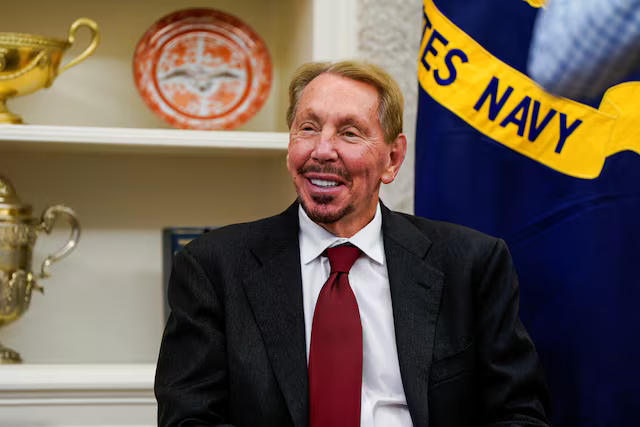
Twenty-five years ago, Fortune magazine’s cover pondered whether Oracle co-founder Larry Ellison might become the world’s richest person, while BusinessWeek declared him “cool again,” noting that “Silicon Valley’s bad boy is having his revenge.” These articles could be published today. The octogenarian Ellison is back in the spotlight after Oracle’s announcement of several new cloud computing deals that have shaken the tech world. The company’s stock soared by 35.9%, pushing Ellison’s net worth to nearly $400 billion, second only to Elon Musk globally.
On Thursday, news broke that Paramount, the media conglomerate now controlled by Ellison’s family, is preparing a bid to acquire the iconic Warner Bros. Discovery. This move could overnight establish their dominance in Hollywood and culture. The charismatic billionaire has been widely known for his yacht collection, ownership of a Hawaiian island, and long-standing support for Donald Trump. Yet, with little public fanfare, he has recently orchestrated a return to the center of power. At Paramount, his son David appears to be shifting CBS News to the right, appointing Kenneth Weinstein, a Trump supporter and former CEO of the conservative think tank Hudson Institute, as the ombudsman for CBS News. He is also reportedly considering Bari Weiss of The Free Press for a leadership role within the news organization.
Ellison has also entered the world of TikTok. In 2022, after national security concerns were raised about the Chinese-owned platform used by over 170 million Americans, Oracle began providing its U.S. tech infrastructure. It’s easy to forget that Ellison’s brash business tactics and lavish lifestyle earned him the “bad boy of Silicon Valley” label since he co-founded Oracle in 1977. In 2010, he even played himself in “Iron Man 2.” Remarkably, Ellison has cultivated a reputation as an uber-tech titan and playboy while also tackling complex and often unglamorous computing challenges. Recently, he helped solve the problem of linking thousands of computers to run artificial intelligence systems. The massive, AI-level money remained elusive until the most recent quarter when the new cloud deals significantly boosted Oracle’s stock price.
In the 1990s, Oracle successfully overcame its database rivals but then missed out on nearly a decade of sales and stock market gains from the industry’s shift to cloud-based business applications. While AI holds tremendous promise for Oracle, success is not guaranteed, as the entire industry is still working to establish a profitable business model. Furthermore, Oracle has forged a particularly close relationship with a single company—OpenAI—which, according to a person familiar with the matter, has committed to paying Oracle $300 billion for computing resources over five years.
Oracle has positioned itself as an “AI landlord,” attracting high-profile clients like Meta and Elon Musk’s xAI, in addition to its new largest customer, OpenAI. This strategic shift has helped revenue soar more than fourfold to $455 billion. “People have definitely questioned him over the years,” said Matthew Durot, deputy editor for wealth at Forbes, which tracks his fortune. With Oracle’s focus on AI, “He’s sort of got the last laugh—at least for now.”
One crucial decision was pivotal: Oracle chose not to build its own custom AI chips, unlike Microsoft, Amazon, and Google. This choice to rely on Nvidia has likely helped it secure more chips from the global leader in AI processors, according to analysts. Ellison himself took the lead. At a dinner in 2024, Ellison brought Musk and Nvidia CEO Jensen Huang to Nobu, his sushi restaurant in Palo Alto. “Please take our money,” Ellison recalled telling Huang. “It worked,” he later added on an earnings call with analysts. Within months of that dinner, Oracle secured more GPUs, finalized a computing deal with OpenAI, and announced a massive, half-trillion-dollar OpenAI computing project, “Stargate.”
Oracle’s first cloud venture in 2016 was a business failure, but its second, launched in 2018, created a service that proved to be cheaper and more flexible than its competitors. In 2020, when Zoom Technologies was struggling with a surge of new traffic during the pandemic, it used Oracle’s cloud, and its service hiccups and outages all but vanished. In 2022, when TikTok moved the data of over 100 million U.S. users to Oracle’s cloud, the transition was largely unnoticeable to users. Analysts praised this as a major technical achievement.
Ellison is known for his penchant for risk, and Oracle’s rush into AI is no different. The company does not purchase land, build data centers, or power plants. It outsources all these functions to partners who may or may not deliver, said Chirag Dekate, a vice president and analyst at research firm Gartner. It also remains uncertain whether partners like OpenAI can amass the capital to pay Oracle, as OpenAI is still building a business it hopes will be profitable. “When you have just one handful of customers, and one of those customers goes away, you are left with a really large hole that you now need to figure out how to fill,” Dekate explained.
