

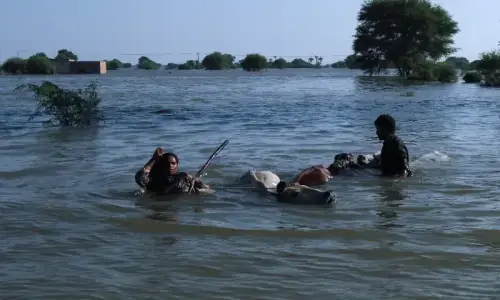
The flood situation has escalated, particularly after Indian authorities issued alerts about rising water levels at Ganda Singh Wala and Ferozepur a few days ago, which triggered renewed evacuations along the Sutlej River.
Although water levels have receded slightly in some areas, the overall flood threat remains severe, with rescue and relief operations extended across multiple districts. At Panjnad Headworks on the Chenab River, water discharge surged to an exceptionally high level, crossing 668,000 cusecs. This surge of 100,000 cusecs within a 24-hour period led to mass evacuations in Alipur tehsil.
In a late-night development, a protective dyke near the city of Shujabad collapsed for the second time, inundating nearby river communities. This downstream pressure has also impacted Sindh’s Guddu and Sukkur barrages, which continue to report medium flood levels with flows exceeding 400,000 cusecs. In Rahim Yar Khan, authorities noted a flow of 660,000 cusecs passing through Chachran Sharif, with no immediate threat to local areas.
According to data from the Flood Forecasting Division (FFD), Panjnad witnessed a steady outflow of over 668,000 cusecs, while Guddu and Sukkur barrages maintained a flow of over 400,000 cusecs. On the other hand, flood levels in Punjab’s rivers receded, with Ganda Singh Wala on the Sutlej River near the Indian border in a “medium” flood state.
The PDMA River Flows report confirmed that while flows were steady at most locations on the Chenab, Ravi, and Sutlej rivers, the rising water downstream of Panjnad Headworks in Rahim Yar Khan prompted further evacuations in the riverine areas of Khanpur and Liaquatpur.
Tragedies and Rescue Operations
The crisis has led to several tragic incidents. In Bahawalnagar, two people drowned after a Rescue 1122 boat carrying 23 evacuees capsized. Another rescue boat in Jalalpur Pirwala overturned, leaving five people, including children, missing. In Muzaffargarh, a single incident resulted in one fatality and two rescues after three teenagers fell into the floodwaters.
Authorities report that thousands have fled their homes in various affected areas. Punjab Relief Commissioner Nabil Javaid stated that over 4,500 villages and more than 4.287 million people have been affected, with over 2.262 million relocated. A total of 396 relief camps, 490 medical camps, and 412 veterinary camps have been established.
Dr. Rizwan Naseer, Secretary of the Punjab Emergency Service, said that in Multan alone, over 13,600 people were rescued in the past three days. Across the province, more than 362,000 people have been evacuated using 139 rescue boats.
Preparedness in Balochistan
NDMA Chairman Lt Gen Inam Haider Malik stated that Pakistan is facing the final monsoon spell of the season and that the floodwater heading south is “losing steam.” He predicted that the situation would stabilize in the next two to three days.
Meanwhile, torrential monsoon rains have lashed several areas of Balochistan, triggering flash floods. The PDMA has issued an alert, directing district administrations to take urgent measures to protect residents. Water levels at Hub Dam have risen to just one foot short of its full capacity, prompting warnings for people living along the Hub River to move to safer locations.
The Balochistan government has also completed arrangements along the left bank of the Indus River in anticipation of floodwaters from Punjab’s rivers. Rescue teams and equipment have been deployed in border areas of Nasirabad division, and officials confirmed that 16 flood control centers are now operating around the clock.
