

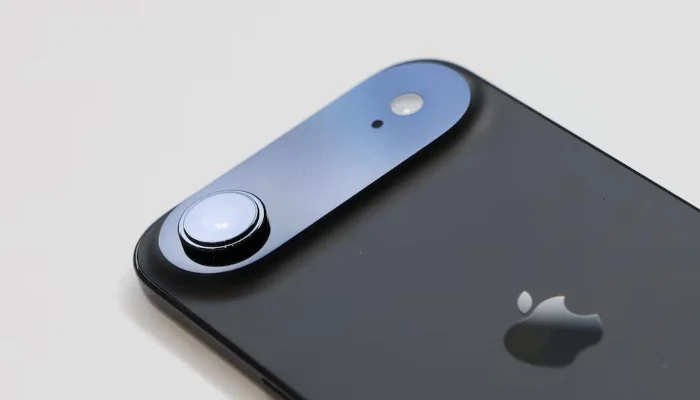
On Tuesday, Apple CEO Tim Cook seemed to be channeling his predecessor, Steve Jobs, as he unveiled the iPhone Air—the company’s slimmest handset yet and the biggest change to a lineup that fans and analysts had considered stagnant for the past eight years.
Cook kicked off the company’s annual product launch event at its Cupertino, California, headquarters with a classic Jobs quote: “For us, design goes beyond just how something looks or feels. Design is also how it works.”
The iPhone Air’s circuitry has been shrunk to the size of a few postage stamps to fit inside its incredibly thin 5.6-mm (0.22-inch) frame, which is even slimmer than Samsung Electronics’ S25 Edge at 5.8 mm. This miniaturization is key to Apple’s claim of “all-day battery life.”
Many analysts had predicted a lukewarm reception for the event, but some now believe the four new iPhones—the Air, 17, 17 Pro, and 17 Pro Max—offer a compelling lineup for customers with diverse budgets. Apple’s stock has faced challenges, losing 6.4% so far in 2025, while other tech giants like Microsoft and Nvidia have seen double-digit gains. Despite this, Apple’s market value of $3.5 trillion makes it the third most valuable company in the S&P 500.
Still, doubts linger about whether the new smartphone will deliver on its promised battery capacity and whether consumers will accept a device with one less camera. The iPhone Air will incorporate Apple’s best and newest A19 Pro processor chip, which is optimized for artificial intelligence tasks, as well as two new custom communications chips.
Gaurav Chaudhary, a popular YouTuber known as “Technical Guruji” with nearly 24 million followers, was impressed. “I heard loud claps the moment it was announced,” he said. He praised the Air’s titanium frame and “ceramic shield” glass, which Apple claims makes the device more durable. Chaudhary, despite having heard numerous leaks about the device, said he was still impressed after handling it in the Steve Jobs Theater at Apple headquarters, though he’s waiting to see if Apple’s battery life claims hold up in real-world use.
Seventeen years ago, Jobs famously introduced the first MacBook Air by pulling the ultra-thin laptop from an interoffice envelope to emphasize its portability. The iPhone Air, which borrows its name and design language from that iconic laptop, might be what Apple fans have wanted for years: a device that stands out from competitors and is packed with hardware engineering feats.
Paolo Pescatore, an analyst at PP Foresight, stated, “I think in an era where we’ve seen a large degree of sameness, it’s great to see Apple bring a new product to the market.” He added that it “kind of reinvigorates the whole segment of iPhone.”
On the downside, the iPhone Air has only one camera, while the base iPhone 17 has two, and the Pro models have three. Ben Bajarin, CEO of technology consultancy Creative Strategies, also said it will be critical to confirm whether the device can live up to Apple’s battery life claims. He believes Apple’s custom chips, which the company has spent over a decade designing with a relentless focus on energy efficiency and size, should help.
The launches did not, however, include any major announcements of new artificial intelligence features that could help Apple close the gap with companies like Alphabet’s Google, which showcases the capabilities of its Gemini AI technology in its latest flagship phones.
Despite this, analysts said the iPhone Air is likely to spur many upgrades, boosting Apple’s sales in the crucial holiday shopping season. Some also believe it could help Apple win back customers in China, where it has lost market share to the slimmer and cheaper smartphones of rivals. However, Will Wong, a senior smartphone analyst at research firm IDC, was more cautious. “We don’t expect the iPhone Air to deliver a major sales boost, as Apple compromised on battery life, cameras, and audio to achieve the slimmer design, features crucial to consumers,” he said.
The iPhone Air is priced in the middle of the iPhone lineup and at $100 less than the debut price of Samsung’s Galaxy S25 Edge, which shipped 1 million units in the second quarter of this year. Nabila Popal, senior research director at IDC’s Worldwide Quarterly Mobile Phone Tracker unit, predicted better sales for the iPhone Air. “Not only because it’s priced better, but because the (iPhone) Plus, which the Air is essentially replacing, already did between 5% and 7% of Apple’s shipments,” she said.
Popal concluded, “Apple’s late, but when they do it, they do it bigger or louder or better than anyone.”
