

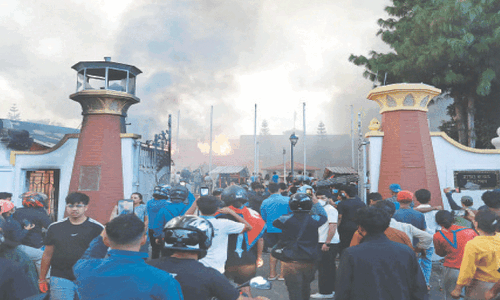
Nepal has been plunged into fresh political uncertainty as Prime Minister K.P. Sharma Oli resigned on Tuesday following widespread protests that turned violent, sparked by his government’s ban on social media. The ban, which was later lifted, led to clashes between police and protesters, resulting in 19 deaths and over 100 injuries.
The protests, which have been called “demonstrations by Gen Z,” were organized by young people frustrated with a perceived lack of action against corruption and a shortage of economic opportunities. Despite the lifting of the ban, the demonstrations continued, with armed protesters setting fire to parliament and Supreme Court buildings and attacking the families of government ministers.
In his resignation letter to President Ramchandra Paudel, Oli stated that he was stepping down to “facilitate the solution to the problem and to help resolve it politically in accordance with the constitution.” Following his resignation, his private residence was set on fire by protesters, and his current whereabouts are unknown.
Call for Calm and International Reaction
President Paudel has begun the process of finding a new prime minister and has also summoned protest leaders for talks. The president, whose offices were also set on fire, pleaded for “all parties to exercise restraint, to not allow further damage.” The army chief, Ashok Raj Sigdel, also urged protesters to end the unrest and engage in dialogue.
Neighboring India and the United Nations have also voiced their concerns. Indian Prime Minister Narendra Modi stated that the “stability, peace and prosperity of Nepal are of utmost importance,” while the UN rights chief, Volker Turk, said he was “appalled” by the violence and called for talks.
Despite the indefinite curfew in the capital, Kathmandu, protesters continued to gather, throwing stones at police and setting fires. Local media reported that some ministers had to be rescued by military helicopters. The International Crisis Group has described the situation as a “major inflection point in the country’s uneasy experience with democratic rule.”
