

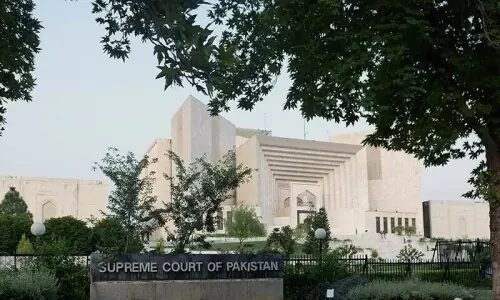
The Supreme Court has set its three-month summer vacation for 2026 under the new Supreme Court Rules 2025, even as a debate continues within the top court over the scope and regulation of judges’ leave.
The annual vacation will run from June 15 to September 14, 2026, under Rule 4 of Order II of the new rules, which replaced the 1980 framework. A full court meeting on Monday, presided over by Chief Justice of Pakistan (CJP) Yahya Afridi and attended by 19 of the 24 sitting judges, approved the rules. The judges agreed that the new rules, described as a living document, will be subject to review and amendment as needed.
Judicial leave has already become a contentious issue. In his address at the opening of the new judicial year on Monday, the CJP noted that while judges can take holidays during annual vacations, routine leave requests during the working year fall under his discretion based on established criteria. A senior counsel, who wished to remain anonymous, commented that the “notification is a kind of forerunner for judges to accumulate and plan their holidays for the next vacations in advance.”
According to the Supreme Court notification, offices will remain open during the vacations, except on public holidays. Urgent and criminal cases, along with matters fixed under the Supreme Court (Practice and Procedure) Act 2023 and Article 191A of the Constitution, will continue to be heard by available benches as directed by the three-judge committee.
The July 29 General Standing Order (GSO), issued under the Supreme Court Judges (Leave, Pension and Privileges) Order 1997 and also uploaded to the court’s website, empowered the CJP to approve leave with due diligence in the interest of public service. It required all types of leave to be applied for in advance with cogent reasons. For judges traveling abroad, a no-objection certificate is mandatory. Private foreign visits should be limited to summer or winter vacations, with exceptions for pilgrimages, official nominations, awards, medical emergencies, or children’s graduation ceremonies. According to the GSO, judges on leave must provide current contact details, and for official visits abroad, the Foreign Ministry will arrange facilitation and protocol.
In response, senior puisne judge Justice Syed Mansoor Ali Shah wrote a seven-page letter to the CJP on September 4. He expressed surprise that, for the first time, the GSO described judges as being at the “whole-time disposal of the state”—language he called entirely alien to a constitutional court. He emphasized that judges are not regimented officers but independent under the Constitution.
Justice Shah also noted that the GSO restricted ex-Pakistan leave to five categories, which are not included in Presidential Order No. 2 of 1997. He regretted that invitations from leading global institutions such as Yale and Harvard universities and recognized professional bodies like the New York City Bar Association had been refused on what he described as “flimsy grounds.”
The letter stated, “Such engagements are not personal leisure but opportunities to carry the institutional presence of this court to global forums, enriching jurisprudence and credibility.” Justice Shah maintained that leave could only be justifiably refused when a part-heard case cannot be adjourned, an urgent administrative duty requires a judge’s presence, or a judge is neglecting work. He regretted that leave was being denied even when none of these conditions applied, apparently to enforce compliance and limit independent judges from addressing international forums. “Such arbitrary denials betray a deep institutional insecurity,” Justice Shah had observed.
