

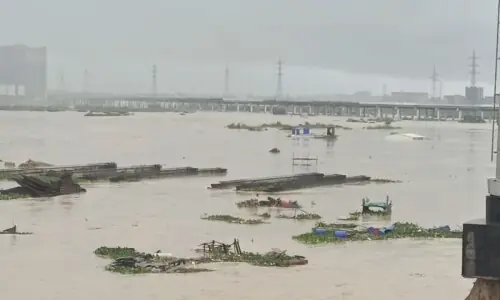
The Lyari and Malir rivers are Karachi’s primary stormwater channels, directing rainwater through a network of drains into the Arabian Sea. Originally natural seasonal streams, they have been severely narrowed by urban expansion, illegal structures, and solid waste, which has turned many into open sewers. This obstruction limits their capacity to handle stormwater, leading to frequent urban flooding during heavy monsoon rains.
The mayor announced on X (formerly Twitter), “So far, 318 people have been rescued [and] moved to safe [places] from around the [areas] close to the Lyari River (drain), and teams are still on the ground.” He added, “All major city arteries and underpasses are clear and open for traffic.”
Meanwhile, the Sindh government ordered the closure of all educational institutions in Karachi following the heavy monsoon rains and a weather alert from the Met Office. A notification from the Karachi commissioner, dated September 9, stated, “All educational institutions (public/private) will remain closed within the territorial jurisdiction of Karachi Division.”
A notification issued yesterday by the Pakistan Meteorological Department (PMD) forecasted “intermittent rain/wind-thunderstorm” for today, with maximum temperatures expected to be between 27 and 29 degrees Celsius. The notification also mentioned, “The minimum temperatures are expected to range between 25 and 27 degrees Celsius, with 85 to 95 percent humidity in the morning and 80 to 90 percent in the evening.” According to the PMD, as of 8 am on Wednesday, Karachi had received 47.7mm of rainfall.
Last night, Sindh Chief Minister Syed Murad Ali Shah instructed Rescue 1122 teams and the district administration to work throughout the night to evacuate people trapped in floodwaters, moving over 350 citizens to safety. According to Rescue 1122 Spokesperson Hassaanul Haseeb Khan, a joint effort with the Pakistan Army resulted in the rescue of 10 people in Saadi Town. “Near Saima Society, two men, three women, and six children were safely moved,” Khan told Dawn.com. “Eight people were trapped in Nashr Basti and Isa Nagri due to waterlogging,” he added.
Due to the widespread rain, two teenagers had also died from electrocution yesterday, and another had drowned in the city. The Met Office said that the deep depression causing rains in Karachi and Sindh would gradually move toward Balochistan and transform into a well-marked low-pressure area.
Several hundred straw-and-mud houses in the rural areas of Tharparkar and Dadu districts were swept away, as both districts had been experiencing intermittent heavy, moderate, and light monsoon rains for the past six and four days, respectively.
