

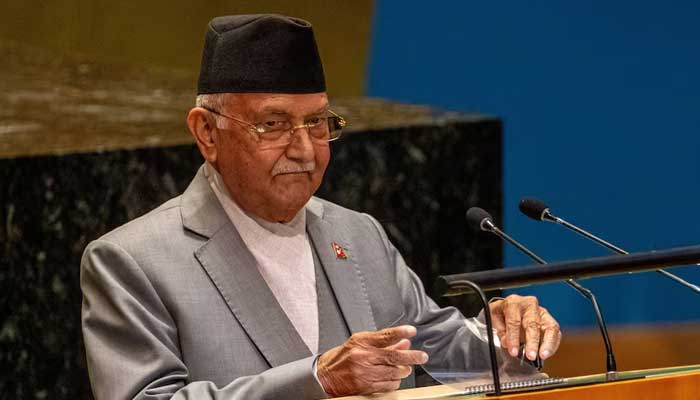
Nepal’s Prime Minister, KP Sharma Oli, resigned on Tuesday after anti-corruption demonstrators defied an indefinite curfew and clashed with police, a day after 19 people were killed in violent protests triggered by a social media ban.
Oli’s government had lifted the ban after protests intensified on Monday, with police firing tear gas and rubber bullets at protesters attempting to storm parliament. The unrest on Monday resulted in 19 deaths and over 100 injuries. However, the protests showed no sign of letting up on Tuesday, ultimately forcing Oli to quit and plunging Nepal into renewed political uncertainty.
This unrest marks the worst in decades for the impoverished Himalayan nation, which is situated between India and China. Nepal has struggled with political instability and economic uncertainty since protests led to the abolition of its monarchy in 2008.
In his resignation letter to President Ramchandra Paudel, Oli stated, “In view of the adverse situation in the country, I have resigned effective today to facilitate the solution to the problem and to help resolve it politically in accordance with the constitution.” An aide to Paudel informed Reuters that the resignation was accepted and the President had initiated the “process and discussions for a new leader.” Following this, the army posted an appeal on X, asking people to “exercise restraint” since Oli’s resignation had been accepted.
Oli, 73, was sworn in for his fourth term in July of the previous year, becoming the country’s 14th prime minister since 2008. Late on Monday, two of his cabinet colleagues resigned, citing moral grounds for their departure. Earlier on Tuesday, Oli had convened a meeting of all political parties, emphasizing that violence was not in the nation’s interest and that “we have to resort to peaceful dialogue to find solutions to any problem.” Oli also expressed sadness over the violent incidents, which he attributed to “infiltration from different selfish centres,” but he did not directly address the protesters’ complaints about corruption.
Despite his resignation, anger against the government showed no signs of abating. Protesters defied an indefinite curfew and gathered in front of parliament and other locations in the capital, Kathmandu. They set fire to tires on some roads, threw stones at riot police, and chased them through narrow streets. Some onlookers recorded the clashes on their mobile phones as thick black smoke billowed into the sky. Witnesses also reported that protesters were setting fire to the homes of some politicians in Kathmandu, and local media stated that some ministers were rescued by military helicopters. Reuters could not immediately verify this information.
Kathmandu Airport Shut Down
The Civil Aviation Authority of Nepal announced that Kathmandu airport, the country’s main international gateway, was closed with immediate effect. Smoke from fires started by protesters nearby was deemed a risk to aircraft safety.
Protester Robin Sreshtha told Reuters TV, “We are still standing here for our future… We want this country corruption-free so that everyone can easily access education, hospitals, medical (facilities)… and for a bright future.”
The protests, which have spread to other cities, are being called “demonstrations by Gen Z.” They are fueled by young people’s widespread frustration with the government’s perceived failure to combat corruption and boost economic opportunities.
One protester, who signed an email to Reuters as ‘A concerned Nepali citizen’, explained that the protest was “intended, first and foremost, against the rampant corruption in government.” The email noted that young Nepalis had been posting on social media about the “luxurious lives of the families and children of corrupt politicians and civil servants,” and the government had responded by cracking down on social media platforms.
Neighboring India, which is home to hundreds of thousands of Nepali migrant workers, expressed hope that all parties would exercise restraint and resolve the issues through talks. A joint statement from the embassies of Australia, Finland, France, Japan, South Korea, the UK, Norway, Germany, and the U.S. in Nepal urged all sides to show “maximum restraint,” avoid further escalation, and protect fundamental rights.
Last week, Oli’s government had imposed a social media ban, blocking access to several online platforms, claiming they had failed to register with the government. Critics argued this was an attempt to stifle free speech, a charge the government denied, citing concerns such as the misuse of social media to spread disinformation and commit fraud.
