

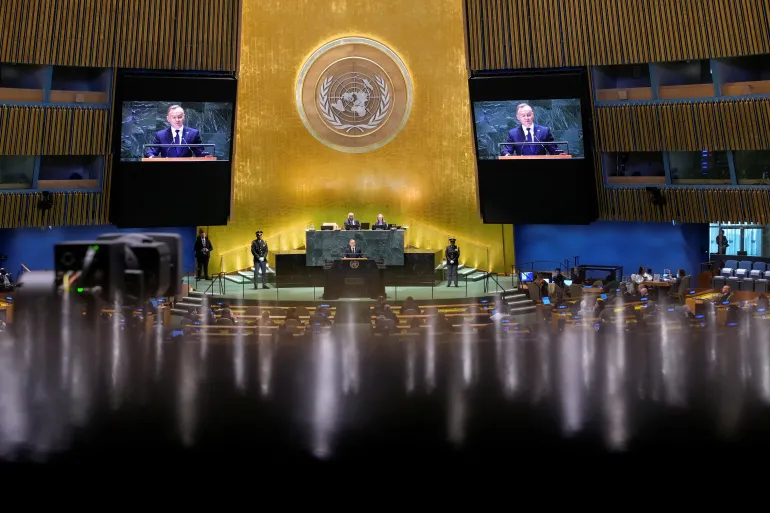
This year’s United Nations General Assembly (UNGA) session is set to convene amid significant political and financial turmoil. The Trump administration’s decision to withhold or revoke visas for Palestinian Authority and Palestinian Liberation Organization officials has already sparked dismay. This comes as France and Saudi Arabia prepare to host a conference on Israel and Palestine, promising to join several European countries in recognizing a Palestinian state.
According to Richard Gowan, the UN director at the International Crisis Group, the gathering marks a year where “illusions have been rather stripped away.” He noted, “It’s now very, very clear that both financially and politically, the UN faces huge crises. Now the question is, is there a way through that?”
When Does It Start?
The proceedings officially began on Tuesday with the new president, former German Minister for Foreign Affairs Annalena Baerbock, presenting her agenda for the session, which will run through September 8, 2026. This year’s theme is “Better Together: 80 years and more for peace, development and human rights.”
The first week will be largely procedural, followed by the “high-level week” starting on September 22. This week will open with a meeting to commemorate the UN’s 80th anniversary and will continue on Tuesday, September 23, with the “General Debate,” where at least 188 heads of state or other high-ranking officials are scheduled to speak through September 29.
What Does the UNGA Do?
The UNGA is the main deliberative and policy-making body of the UN. It is the only body where all 193 member countries are represented, with Palestine and the Holy See holding non-member observer status.
Under the UN Charter, the body is tasked with addressing issues of international peace and security, especially when they are not being handled by the UN Security Council (UNSC). The UNGA also debates matters of human rights, international law, and cooperation in various fields such as economic, social, and health.
Operationally, the UNGA approves the UN’s annual budget and manages the funding for its 11 active peacekeeping missions worldwide.
Will More Countries Recognize Palestinian Statehood?
Israel’s war in Gaza has heavily influenced the agenda, with anticipation focused on several countries that have recently pledged to recognize a Palestinian state. Last week, Belgium became the latest to do so, following France and Malta. Other countries, including Australia, Canada, and the UK, have announced conditional recognition, though it remains unclear if they will act at this gathering.
While full UN membership for Palestine would require a UNSC approval—a move almost certainly to be vetoed by the US—the increased recognition is symbolically significant. Alanna O’Malley, a professor of UN studies at Leiden University, told Al Jazeera that France’s recognition is particularly important as it is the only permanent European member of the UNSC to do so. This puts pressure on the US and, in turn, on Israel, while also highlighting the gap between European nations and the Global South on this issue.
Multilateralism Under Threat
Despite the celebratory tone for the UN’s 80th year, the institution faces significant challenges to global cooperation. During his first term, President Trump withdrew the US from key agreements and bodies, and he has repeated these actions upon taking office again this year. The Trump administration has also implemented widespread cuts to foreign aid for UN agencies, despite the US remaining the largest funder.
This financial instability is compounded by internal questions about Secretary-General Antonio Guterres’s “UN80 Initiative” to streamline the organization. Proposals under this initiative have met with opposition from some member states and staff, leading to a vote of no confidence against the UN chief earlier this year.
A Chance for New Influence?
This year’s gathering could also be marked by efforts from traditionally marginalized countries to gain more influence at the UN. China has been seeking more influence through funding peacekeeping missions, while countries like South Africa and Jamaica have utilized the International Court of Justice (ICJ) to seek accountability for Israeli abuses and climate change.
O’Malley suggests that many Global South countries see this as an opportunity, not a crisis. “This is an opportunity to remake the system of global governance to suit their ends more precisely, and also to serve their people more directly,” she said. This has revitalized interest in long-sought reforms, including expanding the number of permanent members on the UNSC, though a clear path for such a change does not yet exist.
History-Making Moments?
UNGA has a history of dramatic moments, from Hugo Chavez calling George W. Bush “the devil” to Benjamin Netanyahu’s “literal drawing of a red line” on Iran’s nuclear program. It also includes Trump’s inaugural 2017 speech where he pledged to “totally destroy” North Korea, a speech met with laughter.
This time, the tone is expected to be different. However, with rumblings of lower attendance due to travel restrictions, the International Crisis Group’s Gowan suggests this year’s event could be a “swan song” for the tradition of holding the UNGA in the US. “If the US isn’t going to give out visas, then what’s the point of trying to do the global meetings there?” he asked.
