

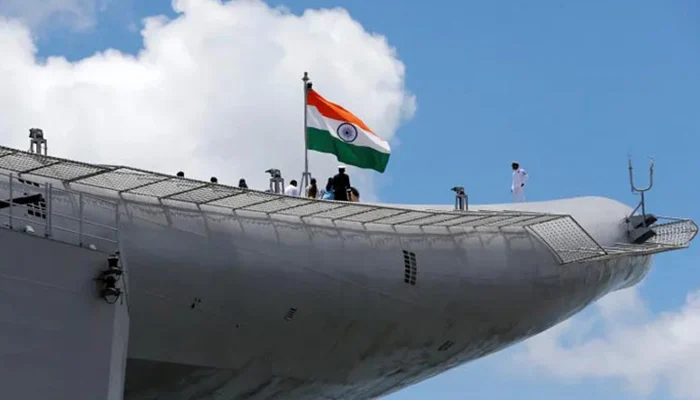
India announced a 15-year defense modernization plan on Friday that could include building its third aircraft carrier, which would be its first to be nuclear-powered. The plan also includes the use of Indian-made fighter jets for the navy for the first time.
Bordered by strategic rivals China and Pakistan, with whom India has had deadly clashes in recent years, New Delhi is increasingly relying on domestic defense companies to strengthen its capabilities and reduce its dependence on foreign suppliers like Russia, France, and the United States.
The defense ministry’s 2025 roadmap states, “As the nation stands on the threshold of embracing greater challenges and responsibilities in the forthcoming decades, it is but imperative that the Services be equipped accordingly.” It adds that “greater private-public sector partnership is thus the road ahead.”
Nuclear Carrier and Indigenous Jets
India currently operates two aircraft carriers, one of Russian origin and one that was built domestically. The proposed third carrier, expected to be nuclear-powered for the first time in India, is being designed for longer reach and stealthier operations. The document outlines the need for at least 10 nuclear propulsion systems to support the carrier and other future warships, underscoring India’s ambition to expand its strategic reach across the Indian Ocean.
India also plans to induct an unspecified number of new-generation twin-engine, deck-based fighters and light combat aircraft, both of which are being developed for the navy by state-owned Hindustan Aeronautics Ltd. In April, India signed a deal with France worth 630 billion rupees (about $8 billion) for 26 Rafale-Marine twin and single-seat jets, made by Dassault Aviation, to be deployed on its two existing carriers: INS Vikrant and INS Vikramaditya.
India hopes to have 62 Rafale jets in service by 2030, including 36 for the air force that started arriving in 2020. Currently, the carriers deploy a fleet of Soviet-origin MiG-29K. The roadmap also anticipates procuring two electromagnetic aircraft launch systems, developed for the US Navy, which use electromagnetic forces instead of traditional steam catapults to launch aircraft from carriers. It also places a strong emphasis on drones, which played a key role in a May military conflict with Pakistan.
India has budgeted approximately 6.81 trillion rupees ($77 billion) for defense this fiscal year. According to World Bank data, it is the world’s fourth-largest defense spender after the United States, China, and Russia.
