

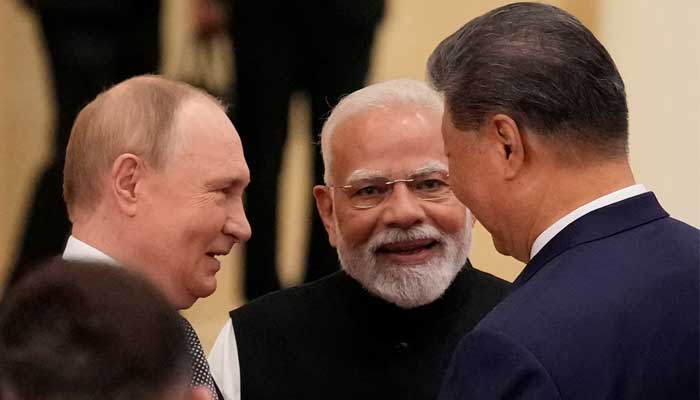
Images this week of Indian Prime Minister Narendra Modi holding hands with Russian President Vladimir Putin at a summit hosted by Chinese President Xi Jinping seem to confirm what many experts have already concluded: the US has stumbled in its effort to draw India into its diplomatic orbit. Successive US presidential administrations have sought to cultivate historically non-aligned India as a strategic counterweight to China and Russia.
However, as the images of Modi in Tianjin highlighted, US President Donald Trump appears to have undercut that goal with a series of actions. These have included imposing 50% tariffs on Indian goods and publicly criticizing New Delhi for what his administration sees as its opportunistic purchases of cheap Russian oil.
The souring of the India relationship comes even as US adversaries China, Russia, and North Korea have tightened their ties, despite Trump’s desire to reset relations with each of them. On Wednesday, the leaders of the three countries appeared together in public for the first time at an event to mark the end of World War II. In a clear signal to Trump, Modi is showing a willingness to boost, rather than reduce, ties with Moscow—and to look past his suspicions of Beijing.
“I fear we are locked into a long downward spiral because neither leader is willing to pursue the personal outreach necessary to repair the relationship,” said Ashley Tellis, who served in the George W. Bush administration and is now at the Carnegie Endowment for International Peace. “The problem now is Trump’s deepening grievances against India,” Tellis added. “He may change his mind down the road, but presently the imperative of securing a trade deal with China trumps all other geopolitical considerations.”
Indian officials have been rankled by having their trade proposals rejected and their rival, Pakistan, honored by Trump. These slights were compounded by the US president claiming credit for resolving tensions between the South Asian neighbors, which India considers a bilateral affair.
Tanvi Madan, an India specialist at the Brookings Institution, said US criticism of Modi’s meetings with Xi and Putin struck Indians as odd, particularly given that Trump himself had rolled out the red carpet for the Russian leader and has his own plans to meet with Xi. “That criticism and pressure on India isn’t going to sway India from seeking strategic autonomy; it is going to reinforce that instinct,” she said.
White House spokeswoman Anna Kelly said Trump’s foreign policy record “is unparalleled because of his uncanny ability to look anyone in the eye and deliver better deals for the American people,” including brokering an India-Pakistan ceasefire. “President Trump and Prime Minister Modi have a respectful relationship, and teams from both the US and India remain in close communication on the full range of diplomatic, defense, and commercial priorities in our strategic partnership,” she said. An Indian official, speaking on condition of anonymity, said the Trump administration’s narrative on India was unjustified, but Delhi continues to engage with it. The official said the warming of relations with China has been happening since October and is not targeted at the US.
China vs. India
Modi’s improving relations with Xi are especially striking given long-standing Sino-Indian tensions and sometimes outright hostility, including a military clash on their disputed border in 2020. His recent trip to China was his first in seven years.
Trump’s recent attacks have cast doubt on the assumption of a mutually beneficial US partnership with India, with his “America First” approach often hitting Washington’s major partners and allies harder than its traditional geopolitical adversaries. “We get along with India very well, but India, you have to understand, for many years it was a one-sided relationship,” Trump told reporters on Tuesday, reprising a theme he has raised multiple times recently.
China, India, and Russia are all original members of the BRICS, a group Trump has dubbed “anti-American.” Peter Navarro, a White House trade adviser, referred to the images of solidarity in Beijing as “a shame to see Modi getting in bed as the leader of the biggest democracy in the world, with the two biggest authoritarian dictators in the world in Putin and Xi Jinping.”
Trump’s advisers say the shift in tone is not a pivot away from India but a move to speak frankly with a partner.
Risks to the Quad
Trump had courted Delhi during his first term, hosting a joint “Howdy Modi” rally in Texas in 2019 and reviving the Quadrilateral Security Dialogue, or Quad, that also includes Japan and Australia. Modi quickly sought to rekindle ties after Trump’s November election victory, but Trump was quick to take aim at trade imbalance and immigration issues. When Modi visited Washington in February, they agreed to work toward a limited trade deal by fall 2025.
India has been expected to host a November Quad summit, with a more explicit focus on security vis-à-vis China. However, Trump has yet to schedule a trip there, according to a person familiar with the issue. Doubts about the meeting have arisen as Trump has set his sights on a major tariff deal with China ahead of a November deadline.
“For now, in Trump’s worldview, there’s no great power competition that requires the Quad,” said Tellis. Fixing the US-India relationship may require more effort than it took to break it. “India is a clear example of a country that for historical, political, and economic reasons won’t simply bow down to Trump,” said Brett Bruen, a former foreign policy adviser to Barack Obama. “They’ve got other options.”
