

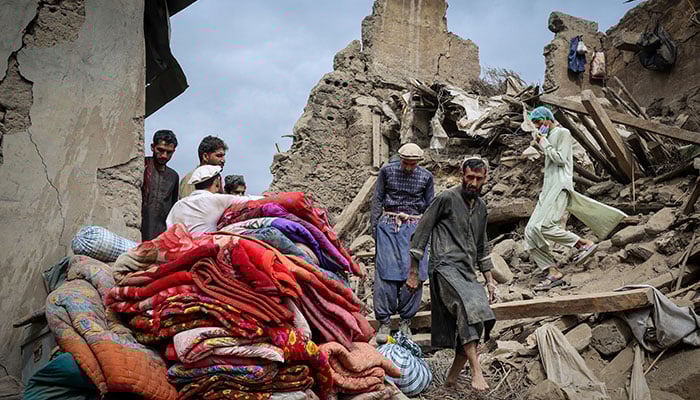
The death toll from the powerful earthquake that struck eastern Afghanistan over the weekend has sharply risen to more than 2,200, making it the deadliest to hit the country in decades. According to a toll from the Taliban government, the vast majority of those killed in the magnitude-6.0 earthquake that jolted the mountainous region bordering Pakistan late on Sunday were in Kunar province, where 2,205 people died and 3,640 were injured.
Another 12 people were killed and hundreds injured in the neighboring provinces of Nangarhar and Laghman. The death toll is expected to rise as volunteers and rescuers are still pulling bodies from the rubble. “Hundreds of bodies have been recovered from destroyed houses during search and rescue operations,” deputy government spokesman Hamdullah Fitrat wrote on X on Thursday, announcing the new toll and adding that “rescue efforts are still ongoing.”
Limited access to the hardest-hit areas of mountainous Kunar province has delayed rescue and relief efforts, with rockfalls from repeated aftershocks obstructing already precarious roads etched into the sides of cliffs. While various countries have flown in aid, hundreds of villagers in the severely affected Nurgal district are still stranded in the open air, with multiple families squeezing under pieces of tarp salvaged from the rubble and uncertain of where their next meal will come from.
A fight broke out over food when some aid finally reached a field in Mazar Dara where hundreds of people were camped out, having received very little assistance. “Yesterday, some people brought some food, everyone flooded on them, people are starving, we haven´t had anything to eat for a long time,” Zahir Khan Safi, 48, told AFP.
‘Every Hour Counts’
Poor infrastructure in the impoverished country, still fragile from four decades of war, has also stymied the emergency response. The World Health Organization (WHO) warned that local healthcare services were “under immense strain,” with shortages of trauma supplies, medicines, and staff. The agency has appealed for $4 million to deliver lifesaving health interventions and expand mobile health services and supply distribution. “Every hour counts,” said WHO emergency team lead in Afghanistan Jamshed Tanoli. “Hospitals are struggling, families are grieving and survivors have lost everything.”
The loss of US foreign aid to the country in January this year has exacerbated the rapid depletion of emergency stockpiles and logistical resources. NGOs and the UN have warned that the earthquake creates a crisis within a crisis, with cash-strapped Afghanistan already grappling with overlapping humanitarian disasters. Filippo Grandi, head of the UN’s refugee agency, said the quake had “affected more than 500,000 people” in eastern Afghanistan.
The country is contending with endemic poverty, severe drought, and the influx of millions of Afghans forced back to the country by neighboring Pakistan and Iran since the Taliban’s 2021 takeover. Even as Afghanistan reeled from its latest disaster, Pakistan began a new push to expel Afghans, with more than 6,300 people crossing the Torkham border point in quake-hit Nangarhar province on Tuesday.
