

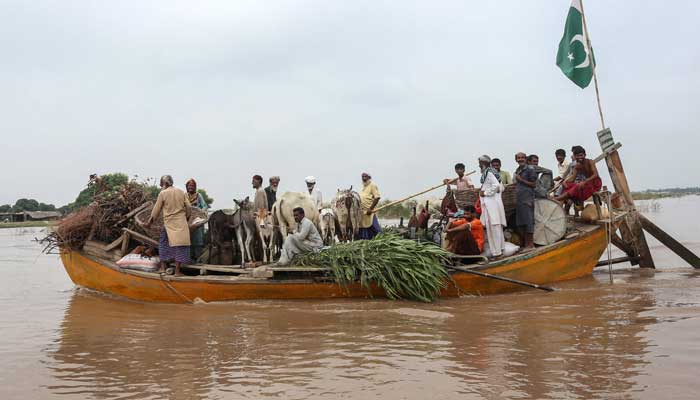
Sindh’s Senior Minister Sharjeel Inam Memon has warned that up to 1.6 million people and 1,657 villages could be affected if floodwaters enter the province in the coming days. Speaking to the media on Saturday, Memon confirmed that the provincial government has mobilized its resources and is taking proactive steps to manage the situation. He noted that ministers are on the ground and district administrations are actively involved in the preparations.
The minister’s remarks come as large areas of Punjab remain submerged, where at least 30 people have died and over 1.5 million have been impacted by the swelling Sutlej, Chenab, and Ravi rivers, which have been intensified by torrential rains and water released from India. Efforts are ongoing to move people to safety, with approximately 481,000 individuals already evacuated from flood-affected regions in Punjab.
According to Memon, the Sindh government has designated 551 locations for relief camps and has 192 rescue boats on standby. An estimated 273,000 families and 167 union councils could be impacted if water levels continue to rise. He stated that floodwaters could reach Sindh between September 2 and 3.
Memon provided current data on barrages, noting that Guddu is discharging 351,000 cusecs of water, Sukkur 289,000 cusecs, and Kotri 251,000 cusecs. He explained that these are well below the barrages’ capacities of 1.2 million, 900,000, and 600,000 cusecs, respectively. He stressed that the current data do not indicate an alarming situation and that conditions could remain under control if there is no further heavy rainfall.
The senior minister emphasized that urban centers are not under immediate threat and advised against spreading speculation. He asserted that the situation does not require emergency measures like requesting army assistance, as the provincial government is self-sufficient and capable of managing the crisis.
Memon also mentioned that people in katcha (riverine) areas are being informed about the situation, as they are most familiar with the water’s behavior. He said residents often “voluntarily move to pucca (settled) areas or stay with relatives” when water levels rise. He also noted that 300 separate camps have been set up for livestock and that 15 districts in Sindh along the riverbanks are being closely monitored.
“Pakistan is among the countries most affected by climate change. Construction must never take place within riverbeds,” Memon remarked, adding that information on water inflows and outflows at barrages will be shared every three hours.
