

Prime Minister Shehbaz Sharif has established a 13-member committee to develop strategies for enhancing Pakistan’s resilience to extreme weather events such as cloudbursts, flash floods, and urban flooding, according to a report by The News on Sunday.
The committee, chaired by Federal Minister for Planning, Development, and Special Initiatives Ahsan Iqbal, includes key federal ministers, secretaries, experts, and stakeholders from across the country. This move follows the devastation caused by floods and torrential rains in Punjab, Khyber Pakhtunkhwa, and Gilgit Baltistan.
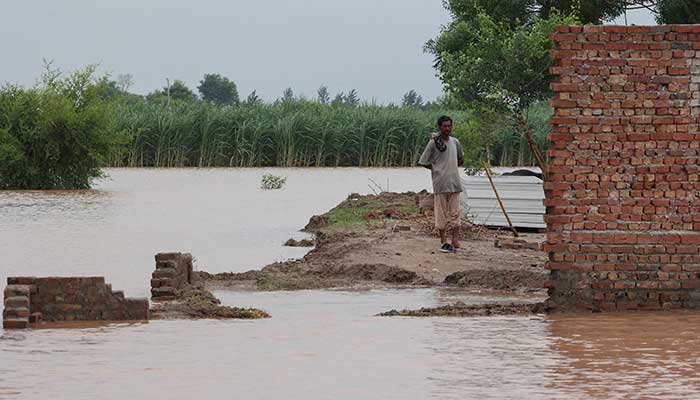
Since late June, over 840 people have died in flood-related incidents nationwide, with extensive damage to infrastructure and property. In Punjab alone, at least 33 people have lost their lives, and more than 2 million have been affected as floodwaters have submerged over 2,200 villages.
The new high-level body’s mandate includes reviewing current institutional frameworks for disaster preparedness and response. It will also evaluate critical infrastructure and recommend measures to address environmental and urban vulnerabilities. An official notification from the Ministry of Climate Change and Environmental Coordination, obtained by the publication, outlines the committee’s comprehensive Terms of Reference (TORs).
These TORs include assessing existing flood protection and drainage infrastructure, exploring funding options (including climate finance) for key Public Sector Development Programme (PSDP) projects, and proposing legal measures to combat deforestation and environmental degradation. The committee will also suggest targeted interventions to reduce urban flooding. It will evaluate early warning systems and recommend installing modern radars, while also working to strengthen the capacity of federal and provincial disaster management authorities, particularly the National Disaster Management Authority (NDMA).
The committee is expected to present a detailed report or presentation to the prime minister within 10 days. The Ministry of Climate Change will provide secretarial support.
In a related development, a special policy dialogue forum has also been formed to engage all stakeholders, including provincial governments, federal ministries, semi-government bodies, civil society, and the media. This forum will meet bi-weekly to shape short-, medium-, and long-term national strategies for climate adaptation and disaster mitigation.
The forum’s members include federal ministers for climate change, communications, and water resources, along with the Prime Minister’s Advisers on Political Affairs and Inter-Provincial Coordination, federal secretaries, the NDMA Chairman, and irrigation and environment secretaries from all four provinces. Representatives from Azad Jammu and Kashmir and Gilgit Baltistan are also included, as is the Director General of the Pakistan Meteorological Department (PMD).
This dialogue committee will review the preparedness of federal and provincial authorities to handle natural disasters, assess financial requirements for water reservoirs and flood mitigation projects, and monitor the progress of flood prevention and drainage schemes. It will also focus on restoring natural water channels by removing encroachments and propose new legislation to penalize negligence related to deforestation. Additionally, the committee will work on upgrading forecasting infrastructure to improve monsoon predictions and help develop urban drainage strategies for efficient rainwater removal.
