

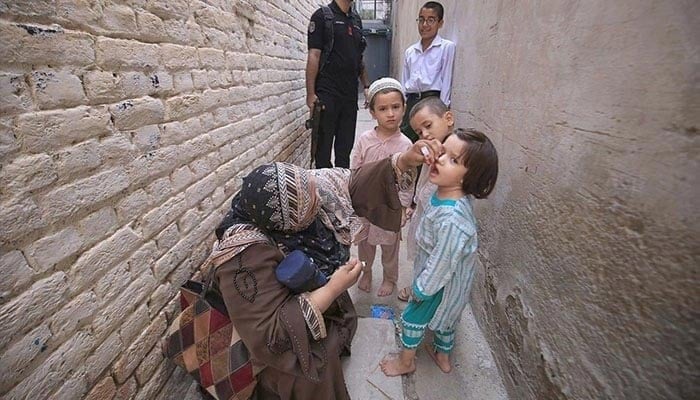
Pakistan is set to launch a new nationwide anti-polio campaign on September 1 in three provinces, while in Punjab, the campaign will begin on September 10.
Federal Minister for National Health Services, Regulations and Coordination, Syed Mustafa Kamal, accompanied by MQM-Pakistan leader Anis Qaimkhani, held a press conference at his camp office in Karachi on Friday. The conference addressed the upcoming nationwide polio campaign and the ongoing flood situation in Pakistan.
During the presser, Kamal stated that the polio virus has been detected in sewage samples from 127 districts across the country, including all districts of Karachi. He noted that out of the 26 cases reported this year, 16 were from Khyber Pakhtunkhwa, with 13 of those cases emerging from southern KP, where security challenges had hindered vaccination efforts.
Meanwhile, the National Emergency Operations Centre (NEOC) has postponed the polio vaccination campaign in nine districts of Punjab due to the ongoing flood situation. The campaign has been delayed in Lahore, Sheikhupura, Kasur, Okara, Gujranwala, Sialkot, Multan, Muzaffargarh, and Bahawalpur. However, the polio drive will proceed as scheduled in Rawalpindi, Mianwali, Faisalabad, and Dera Ghazi Khan, as well as in Attock, Rajanpur, and Rahim Yar Khan.
Highlighting the gravity of the situation, Kamal said, “The only solution to protect children from polio is repeated administration of polio drops. All religious scholars and madrasas have declared the vaccine safe, and we must depoliticize the fight against polio. Afghanistan and Pakistan are conducting synchronized polio drives, and with joint efforts, we will soon rid the country of this crippling disease.”
The health minister also emphasized that parents in Karachi show the highest resistance to polio vaccination, noting that door-to-door campaigns are underway across Pakistan.
Turning to the flood situation, Kamal said the government has responded to all requests for medicines and medical equipment from flood-affected areas. He stated that federal and provincial governments are in constant coordination, and a Command and Control Room has been established at the National Institute of Health (NIH) to monitor the situation. He added that NDMA teams are in close contact with the Ministry of Health.
Kamal stressed that natural disasters cannot be managed by provincial or federal governments alone and called for strengthening the local government system, which he described as the most effective mechanism for disaster management.
He added, “Our country is functioning under provincial and federal structures, but disasters of such magnitude cannot be managed without empowered local bodies. We need administrative reforms and the creation of new units on administrative grounds, not to divide the country but to strengthen governance and ensure delivery at the grassroots level.” The minister concluded by pointing out that while provinces collectively received Rs 8,700 billion, there is no mechanism to ensure those resources reach the lowest tiers of government. He called for transparent planning and effective utilization of funds.
