

Britain, France, and Germany, known as the ‘E3’, are pressuring Iran to accept a deal that would prevent new UN sanctions from being imposed. The three European powers stated that the offer gives Tehran more time for talks on its nuclear program, but only if it allows inspectors to return and eases Western concerns about its uranium stockpiles.
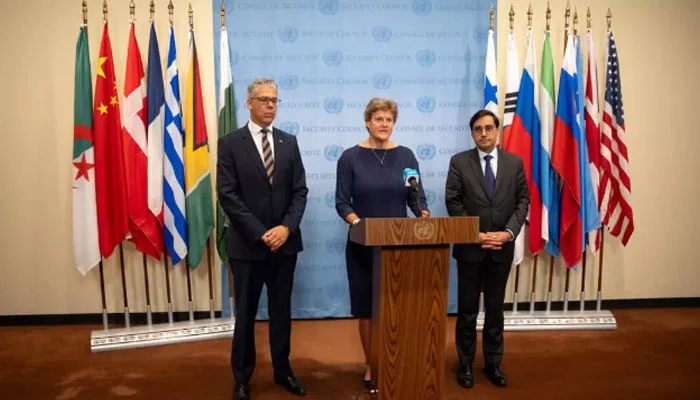
The UN envoys for the three countries issued a joint statement before a closed-door Security Council meeting, a day after they began a 30-day process to re-impose UN sanctions on Iran over its disputed nuclear program.
The E3 offered to delay the reinstatement of sanctions, known as ‘snapback’, for up to six months if Iran would restore access for UN nuclear inspectors, address concerns about its stock of enriched uranium, and engage in talks with the United States.
“Our asks were fair and realistic,” said Britain’s UN Ambassador Barbara Woodward, who read the statement. “However, as of today, Iran has shown no indication that it is serious about meeting them.” With her German and French counterparts standing next to her, she added, “We urge Iran to reconsider this position, to reach an agreement based on our offer, and to help create the space for a diplomatic solution to this issue for the long term.”
In response, Iran’s UN Ambassador Amir Saeid Iravani said the E3 offer was “full of unrealistic preconditions.” “They are demanding conditions that should be the outcome of negotiations, not the starting point, and they know these demands cannot be met,” he told reporters.
Iravani said the E3 should instead support “a short, unconditional technical extension of Resolution 2231,” which is the resolution that established the 2015 nuclear deal. That deal lifted UN and Western sanctions on Iran in exchange for curbs on its nuclear program.
Sino-Russian Draft
Russia and China have proposed a draft UN Security Council resolution that would extend the 2015 deal for six months and urge all parties to immediately resume negotiations. However, they have not yet requested a vote.
The two countries, which are strategic allies of Iran, have removed controversial language from the draft—which they initially proposed on Sunday—that would have prevented the E3 from reimposing UN sanctions on Iran.
Iravani described the Russian and Chinese draft resolution as a practical step to provide more time for diplomacy. A resolution needs at least nine votes in favor and no vetoes from the US, France, Britain, China, or Russia to pass.
UN nuclear inspectors have returned to Iran for the first time since it suspended cooperation with them following attacks on its nuclear sites in June by Israel and the United States. However, Iran has not yet reached an agreement on how it would resume full cooperation with the International Atomic Energy Agency.
