

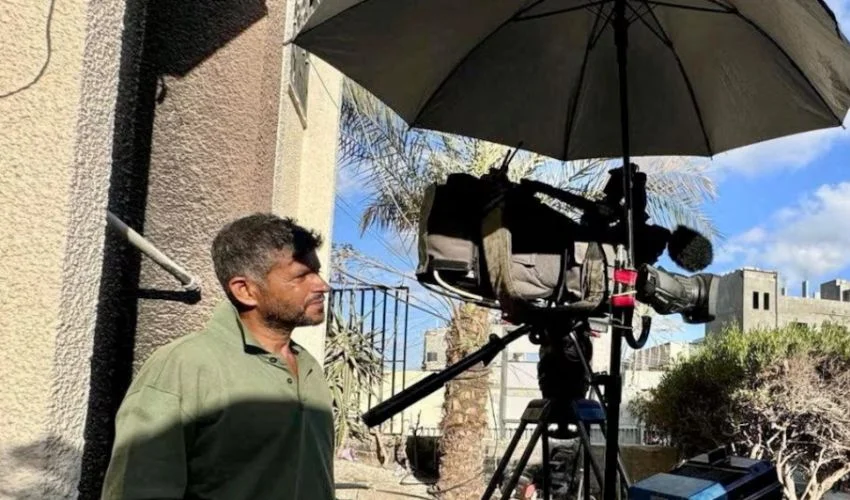
Hussam al-Masri, the Reuters journalist killed by Israeli fire on Monday while operating a live video feed at Gaza’s Nasser Hospital, was reporting on the war’s civilian suffering while he himself was living in a tent and struggling to find food for his family.
Journalist colleagues said that Masri, 49, was an experienced cameraman whose positive attitude in the most dangerous situations made him popular within Gaza’s close-knit community of reporters. “Tomorrow will be better,” he would say, even as conditions in the Palestinian enclave spiraled further into hunger and desperation in the months leading up to his death.
That’s how he ended his last conversation with Mohamed Salem, a senior visuals journalist for Reuters who had known Masri since 2003 and worked alongside him in Rafah, in the south of Gaza, last year. Salem, who left Gaza later in 2024 but was in daily touch with Masri until Monday morning, said that his optimism and smiles made him a pleasure to work with.
Reuters editor in chief Alessandra Galloni said, “Hussam was deeply devoted to telling the story of Gaza to the world.” She added, “He was strong, steady, and courageous in the most challenging of circumstances. His loss is deeply felt by all of those in this newsroom who worked with him.”
According to Reuters video, Masri’s body was recovered alongside his camera in an external stairwell at the hospital, from where he had been broadcasting the view across Khan Younis when the Israeli strike hit. A second blast on the stairwell minutes later killed at least 19 people, including rescue workers and four journalists who had worked for outlets including the Associated Press, Al Jazeera, and others. One of the four, Moaz Abu Taha, provided visuals to Reuters and others. Reuters photographer Hatem Khaled was injured in the second attack while on the stairs filming the aftermath of the first blast.
On Tuesday, the Israeli military told Reuters that the journalists for Reuters and the Associated Press were not “a target of the strike.” Israeli Prime Minister Benjamin Netanyahu said Israel deeply regretted what he called the “tragic mishap” at the hospital. The Committee to Protect Journalists, which said after the strikes it had documented a total of 189 Palestinian journalists killed by Israel during the war in Gaza, has called on the international community to hold Israel accountable and on Monday said, “the perpetrators must no longer be allowed to act with impunity.”
Masri’s wife, Samaher, 39, has cancer, and he had been trying to get her out of Gaza for treatment before he was killed. The couple had four children: Shahd, 23, Mohammed, 22, Shatha, 18, and Ahmad, 15.
Masri was born and raised in Khan Younis in the southern Gaza Strip. He earned a diploma in journalism before beginning freelance work in 1998, including for the Palestinian Broadcasting Corporation. His wife said his passion for journalism stemmed from a desire to show the world what was happening in Gaza. His brother, Ezzeldin al-Masri, said, “This was Hussam’s role in the media: to deliver the truth to the outlets. The camera is recording, whether for or against us. The camera recorded whether there were Palestinian gunmen or Israeli occupation forces.”
The family fled their home when the Israeli military ordered all civilians to leave Khan Younis as it expanded its offensive there shortly after the war started in response to the Hamas attacks of October 2023. The family later learned their home had been destroyed. In a video he recorded of himself and posted to a WhatsApp group shared with other journalists last year, Masri described his grief at the loss of his home and neighborhood. “Nothing remains but ruins – ruins we weep over,” he said. The family returned to Khan Younis in July of last year, taking shelter in a tent.
Live Broadcasts
Masri began working for Reuters as a contractor in Rafah near the border with Egypt in May 2024, eight months into the conflict. In his role, he was involved in live broadcasting from displacement camps and recording the entry of humanitarian aid through the Rafah border crossing. Since returning to Khan Younis, he was responsible for the feed Reuters broadcast daily from Nasser Hospital, which provided a constant real-time display of Gaza and was used by Reuters media clients around the world.
Labib Nasir, Reuters’ visual editor for the Middle East and North Africa, said, “Hussam has done this grueling task day in and day out for months, mainly from Nasser Hospital but also from Rafah when the story merited it.” Masri also reported stories around southern Gaza, often using contacts he had developed at the hospital to provide vivid accounts of the unfolding humanitarian disaster, including stories on malnutrition in Gaza, parts of which are officially in famine.
His last such story, filmed on Saturday, showed families mourning over the bodies of relatives, including children, killed in Israeli strikes that have taken at least 62,000 Palestinian lives in the war. Salem, who spoke to him each morning as he set up his camera, said Masri had chosen to look after the live feed at Nasser Hospital in part because he believed it was the safest place he could operate from. During their final conversation, Masri described how difficult life had become in Gaza and the struggle to find food.
Hours later, in an image captured by Reuters, his body was laid out on a stretcher.
