

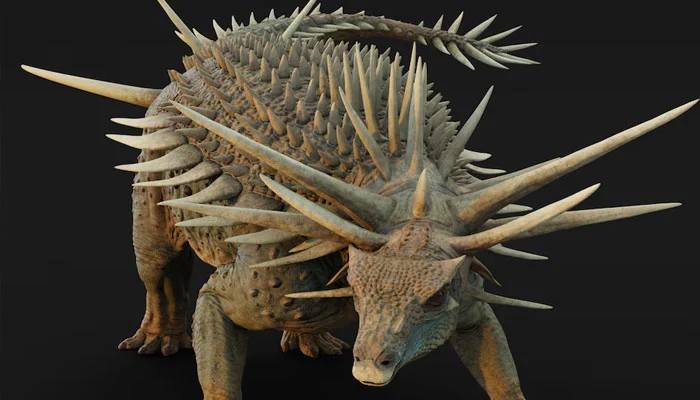
Approximately 165 million years ago, in what is now a coastal floodplain in Morocco, lived one of the most extreme dinosaurs ever recorded. This creature was lavishly adorned with armor and spikes—some reaching up to three feet (one meter) in length—unlike any other known animal, as reported by Reuters.
On Wednesday, researchers described extensive fossilized remains of this Jurassic Period dinosaur, named Spicomellus, discovered in the Atlas Mountains near the Moroccan town of Boulemane.
Roughly 13 feet (four meters) long and weighing between one to two tons, Spicomellus is the oldest-known member of a group of tank-like armored dinosaurs called ankylosaurs. These were squat, slow-moving plant-eaters that walked on four legs.
“The armor of Spicomellus is jaw-droppingly weird, unlike that of any other dinosaur – or any other animal alive or dead – that we’ve ever discovered,” said vertebrate paleontologist Richard Butler of the University of Birmingham in England, who co-led the research published in the journal Nature.
Butler added, “Not only did it have a series of sharp, long spikes on each of its ribs – unknown elsewhere among animals – but it had spines the length of golf clubs sticking out in a collar around its neck.”
The extravagant armor may have served a dual purpose: as a defense against large meat-eating dinosaurs and as a display to attract mates. Butler commented, “The armor surely had some defensive function, but it’s difficult to imagine how the meter-long spikes around the neck were used for defense. They seem like enormous overkill.”
According to vertebrate paleontologist and study lead author Susannah Maidment of the Natural History Museum in London, structures in living animals that seem to have no obvious function and are cumbersome to carry—like a deer’s antlers or a peacock’s tail—are typically associated with sexual selection.
“They could be used in courtship or territorial displays, or to fight against members of the same species during competitions for mates. Spicomellus’ armor is totally impractical and would have been a bit annoying in dense vegetation, for example. So we think that it is possible the animal evolved such elaborate armor for some sort of display, perhaps to do with mating,” Maidment added.
While the fossils did not form a complete skeleton, the partial remains—discovered in 2022 and 2023—provided a solid understanding of Spicomellus. This dinosaur was previously known only from a single rib fragment described in 2021.
Its back was covered in short spikes due to ribs with spikes on their top surfaces. It had a bony collar with plates and two pairs of spikes projecting outward above the neck, including one 2.85 feet (87 cm) long that was likely even longer in life. It also had a pelvic shield and two large outward-projecting spikes above its hips.
Distinctive fused tail vertebrae suggest that Spicomellus possessed a weapon at the end of its tail to fend off predators—perhaps a club or spikes—though none was found among the remains. These fused tail vertebrae have only been found in ankylosaurs with tail weapons, indicating that such weapons appeared in ankylosaurs about 30 million years earlier than previously thought.
Ankylosaurs were among the most successful herbivorous dinosaurs, closely related to another group of plant-eaters called stegosaurs that had bony plates on their backs and spiky tail weapons. Both groups originated during the Jurassic Period. However, ankylosaurs outlasted stegosaurs, thriving until the asteroid impact 66 million years ago at the end of the Cretaceous Period, which ended the age of dinosaurs.
The best-known member of the group, Ankylosaurus, was larger than Spicomellus, at roughly 26 feet (8 meters) long, and lived in western North America during the final years of the dinosaurs. Its armor, including a formidable tail club, provided protection against predators, including the Tyrannosaurus.
Early members of dinosaur groups often have a plainer body plan compared to their later counterparts. Spicomellus proves this was not the case for ankylosaurs. Butler concluded, “The armor of Spicomellus is much more elaborate than that of later ankylosaurs, and no later ankylosaurs have spiky ribs. What is surprising to us is that the most elaborate ankylosaur armor of all time is present in the oldest member of the group. Perhaps the simpler armor in later species reflects a shift towards the armor having a primarily defensive function due to increased predation pressure in the Cretaceous,” when predators became exceptionally large.
