

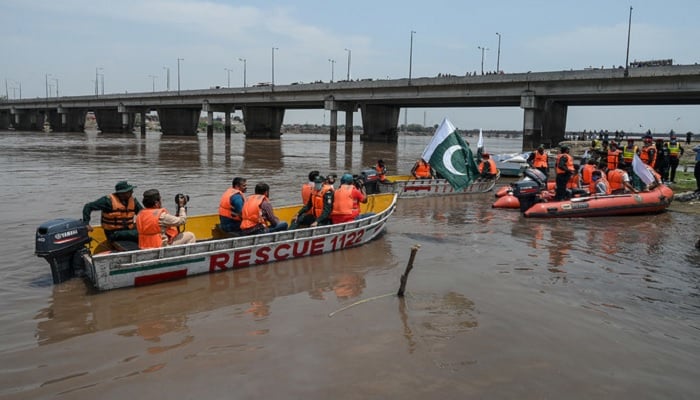
The National Disaster Management Authority (NDMA) has issued an alert for potential flooding in the Ravi River, following increased water releases from India’s Madhopur Headworks. This alert comes just a day after New Delhi had warned Islamabad about planned releases into the Sutlej and Chenab rivers, which have already inundated parts of Pakistan.
Diplomatic sources told Geo News that New Delhi made a second contact with Pakistan in two days on Monday to warn about a potential flood in the Sutlej River, having previously issued a warning about the Tawi River at Jammu. The Tawi is a major tributary of the Chenab that flows through the Jammu region in the Indian-Illegally Occupied Jammu and Kashmir (IIOJK) and Sialkot District of Punjab, Pakistan.
This marks India’s first significant diplomatic contact with Pakistan since a military stand-off in May. The confrontation began after New Delhi’s attempt to link the Pahalgam terror attack in IIOJK to Islamabad and its decision to suspend the Indus Waters Treaty (IWT).
In its advisory, the NDMA stated that heavy rainfall is forecast across Indian states, including Himachal Pradesh and Uttarakhand, which could cause rivers and streams flowing towards Pakistan to swell. The authority’s National Emergency Operations Centre is monitoring the situation round the clock.
According to forecasts, the Ravi River at Jastar is expected to reach high flood levels within the next 48 hours, with flows between 80,000 and 125,000 cusecs. In the upper catchment of the Chenab, water levels in the Jammu Tawi and Munawar Tawi streams are also expected to rise, while the Chenab’s discharge at Marala could increase to between 150,000 and 200,000 cusecs.
The situation on the Sutlej remains alarming. At Ganda Singh Wala in Kasur, officials warned that the river’s flow could rise to 220,000 cusecs. On Monday, the Flood Forecasting Division (FFD) confirmed the river was already at a very high flood level there, with a discharge reaching 188,810 cusecs.
The NDMA also noted that India’s Thein (Ranjit Sagar) Dam is near its storage capacity, increasing the risk of further water releases. Smaller streams and nullahs—including Aik, Deg, Bein, Basantar, and Palkhu—are also anticipated to have higher flows. The FFD also reported a medium flood at Head Sulemanki and at Jassar on the Ravi, where the water flow has surged to 82,140 cusecs. A low flood is underway at Kotri Barrage on the Indus, with an inflow of 217,490 cusecs, while Sukkur Barrage continues to face a medium flood. Low flood levels have also been reported at Tarbela, Kalabagh, Chashma, and Guddu.
Prime Minister Shehbaz Sharif has directed the NDMA to hold daily monsoon review meetings. The authority said it is supporting provincial and local departments to strengthen preparations and relief efforts.
The Foreign Office reaffirmed in a statement on Monday that India is obligated to fully comply with all provisions of the treaty. It added that India’s unilateral declaration to hold the IWT in abeyance is a serious violation of international law that could have significant negative consequences for peace and stability in South Asia. Following the latest alert, authorities have issued warnings based on the information provided by India.
New Delhi accuses Islamabad of orchestrating the deadly militant attack, an allegation that Pakistan denies. Based on these allegations, India waged a war against Pakistan in May, which resulted in the heaviest military engagement in decades before a ceasefire was brokered by the US. The water treaty has survived three wars and other conflicts between the two rivals, withstanding many diplomatic twists and turns.
Reuters reported on May 16 that Delhi is considering projects that would likely reduce the flow of water into Pakistan from rivers allocated to that country. India has also said it will “keep the treaty in abeyance until Pakistan credibly and irrevocably abjures its support for cross-border terrorism.” In contrast, Islamabad says “any attempt to stop or divert the flow of water belonging to Pakistan” will be an “act of war.”
