

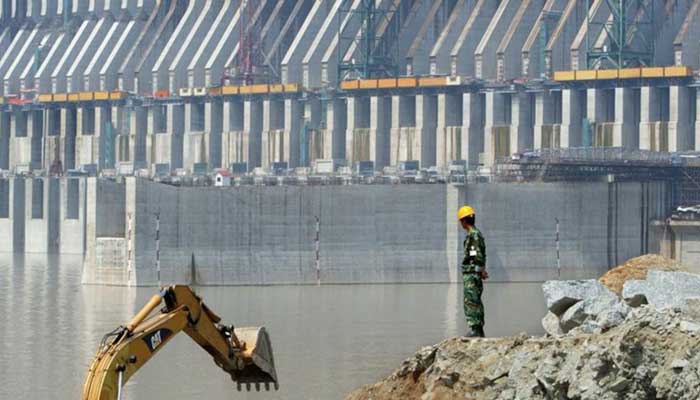
India fears a massive Chinese dam planned for Tibet could reduce water flow on a major river by up to 85% during the dry season, according to a government analysis and four sources familiar with the matter. This has prompted New Delhi to accelerate plans for its own dam to mitigate the effects.
Since the early 2000s, the Indian government has been considering projects to control water flow from Tibet’s Angsi Glacier, which provides water to over 100 million people downstream in China, India, and Bangladesh. However, these plans have faced fierce and sometimes violent opposition from residents of the border state of Arunachal Pradesh, who are concerned that their villages will be submerged and their way of life destroyed.
Then, in December, China announced it would build the world’s largest hydropower dam in a border county just before the Yarlung Zangbo river enters India. This announcement heightened fears in New Delhi that its long-standing rival, which has some territorial claims in Arunachal Pradesh, could use its control of the river as a weapon. The river, which originates in the Angsi Glacier, is known as the Siang and Brahmaputra in India.
In May, India’s largest hydropower company moved survey materials under armed police protection to a prospective site for the Upper Siang Multipurpose Storage Dam, which would be the country’s biggest dam if completed. Senior Indian officials have been holding meetings to fast-track construction, including one organized by Prime Minister Narendra Modi’s office in July, according to two sources who spoke on condition of anonymity due to the sensitive nature of the information.
Delhi’s concerns were detailed in an undated Indian government analysis of the Chinese dam’s impact, which Reuters has corroborated with four sources. Beijing has not released detailed plans, but the analysis was based on past work by Indian government-affiliated institutions and considered the expected scale of the Chinese project, which broke ground in July and is projected to cost nearly $170 billion.
According to sources and the document, Delhi estimates the Chinese dam will allow Beijing to divert as much as 40 billion cubic meters of water, or over a third of the annual flow at a key border point. The impact would be particularly severe during non-monsoon months, when temperatures rise and land across large parts of India becomes barren. The Upper Siang project, with its projected 14 BCM storage capacity, would help alleviate this by allowing India to release water during the dry season. This could mean that the major regional city of Guwahati, which depends on water-intensive industry and farming, would see a supply reduction of 11% instead of 25% if the Indian dam is not built. Sources also said the project could help mitigate any move by Beijing to release devastating torrents of water downstream.
According to the document and sources, if the dam is kept at its minimum drawdown level (where water is stored at less than 50% of its height), it could fully absorb any excess water released from a breach in Chinese infrastructure. Two of the sources said India is considering a proposal to keep 30% of its dam empty at all times to account for unexpected surges.
In response to Reuters’ questions, a spokesperson for China’s foreign ministry said the hydropower projects “have undergone rigorous scientific research on safety and environmental protection, and will not adversely impact the water resources, ecology, or geology of downstream countries.” The spokesperson added that “China has always maintained a responsible attitude toward the development and utilisation of transboundary rivers and has maintained long-term communication and cooperation with downstream countries such as India and Bangladesh.”
Modi’s office and the Indian ministries responsible for water and external affairs did not respond to Reuters’ questions. State-owned hydropower major NHPC also did not return a request for comment. India’s foreign ministry has said that top diplomat S. Jaishankar raised concerns about the dam during a meeting with his Chinese counterpart on August 18. A Jaishankar deputy also told lawmakers in August that the government was implementing measures, including building the dam, to safeguard the lives and livelihoods of citizens in downstream areas.
India itself has been accused of weaponizing water by Pakistan, a Chinese ally with which it briefly clashed in May. Delhi this year suspended its participation in a 1960 water-sharing treaty with Islamabad and is considering diverting flows from another crucial river away from its downstream neighbor. An international tribunal has ruled that India must adhere to the agreement, but Delhi claims the panel lacks jurisdiction.
Development or destruction?
When NHPC workers moved surveying materials near the village of Parong in May, angry locals damaged their machinery, destroyed a nearby bridge, and looted the tents of police sent to guard the operation. Many of them are members of Arunachal’s Adi community, who live off paddy, orange, and sweet lime farms in the mist-shrouded hills and valleys nourished by the Siang.
Villagers have set up makeshift watch posts on regional roads to prevent NHPC workers from accessing the site. This has forced security personnel to trek miles, often under cover of night, to reach the prospective dam site. According to two sources, at least 16 Adi villages are likely to be lost to the dam’s storage area, directly affecting an estimated 10,000 people. Community leaders say more than 100,000 people will be impacted overall.
“The cardamom, paddy, jackfruit, and pear we grow on this land help educate our children and support our family,” said Odoni Palo Pabin, an Adi grocer and mother of two. “We will fight the dam to the death.”
The dam has the support of Arunachal’s chief minister, a member of Modi’s party, who has called the Chinese project an existential threat. The state government said in a statement that the project will “ensure water security and provide flood moderation to counter any potential water surges,” adding that it decided in June to engage in detailed compensation discussions with the affected families.
Lawmaker Alo Libang, an Adi who represents an area that would be submerged by the Indian project, said he believed locals could be convinced to move if they received generous compensation. Three sources, citing instructions from Modi’s office, said NHPC plans to spend over $3 million on education and emergency infrastructure to incentivize villagers to move elsewhere. In a sign of progress, three villages in the area recently agreed to let NHPC officials carry out dam-related work, according to the Arunachal government and dozens of locals.
India has a history of activist movements against large dams, which have sometimes slowed projects by years or forced them to scale down. Even if the Upper Siang dam gets the green light, it could take a decade to build after breaking ground, according to four sources. This means the project would likely be completed after China’s project, which Beijing expects to start generating power by the early-to-mid 2030s. Two sources said that this delay makes an Indian project vulnerable during construction if Beijing suddenly releases water during the monsoon season, triggering a surge that could wash away temporary dams.
International experts and Adi activists have also warned that building large dams in seismically active Tibet and Arunachal could heighten risks for downstream communities. Sayanangshu Modak, an expert on the India-China water relationship at the University of Arizona, said the Chinese “dam is being built in a zone of high seismicity and in a zone that experiences extreme weather events.” “These kinds of extreme weather events trigger landslides, mudslides, glacial lake outburst flooding,” he said. “So that raises concerns about dam safety… it’s a very legitimate concern, and India should engage with China.”
