

The National Accountability Bureau (NAB) has expressed serious concerns regarding the low minimum price set for the auction of gold blocks in the Indus and Kabul rivers, stating that the province is losing trillions of rupees. The bureau has also exposed multiple irregularities during the gold extraction operations.
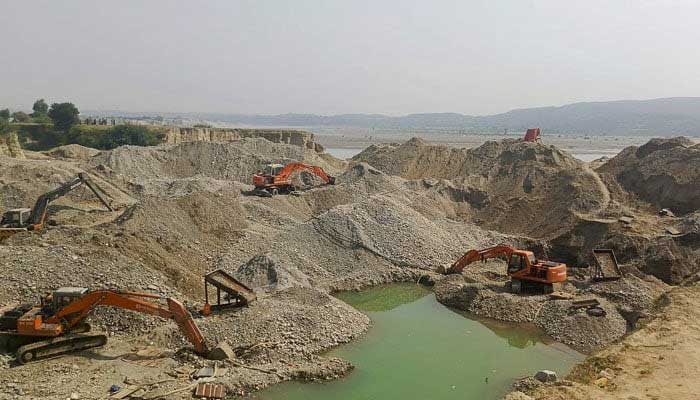
According to official provincial government documents, NAB has highlighted that leaseholders are openly subletting the blocks and charging between Rs500,000 to Rs700,000 per excavator per week. Their estimated weekly income ranges from Rs750 million to Rs1 billion, which accumulates to trillions of rupees, while the government is receiving a minimal amount in return.
Khyber Pakhtunkhwa Chief Minister Ali Amin Gandapur informed a reporter that his government had auctioned the gold placer blocks at high prices. He mentioned that previously, a single block’s auction price had reached Rs650 million, but his administration had set the minimum price at Rs1.10 billion and successfully sold four blocks for approximately Rs4.6 billion for a ten-year period. He emphasized that no auction had taken place for the past 20 years, and illegal gold extraction had been ongoing.
The chief minister stated that the project was advertised two to three times, but the bids were low. He reiterated that his government auctioned it at a much higher rate. He questioned who stopped the geological study that was initiated in 2023.
He also said that when the auction was held, a letter was sent to NAB and one of its officers was present. He maintained that all legal requirements were fulfilled. The CM also said that operations are ongoing to curb illegal mining.
According to the documents, during a high-level meeting at NAB headquarters on August 7, attended by top provincial officials, including the Chief Secretary and Secretary of Minerals, a NAB inquiry revealed that the gold blocks’ reserve price was deliberately miscalculated. A 2015 study by the National Centre of Excellence in Geology, Peshawar, which had identified gold reserves ranging from 0.21 to 44.15 grams per ton, was intentionally ignored. Instead of following the KP Auction Rules 2022, the department interfered to benefit specific bidders.
Additionally, the geological mapping project started in 2022 to estimate new mineral resources was halted in November 2023, specifically for placer gold, raising suspicions of intentional concealment. Previous auctions had also failed due to poor public notice, which did not attract international investors.
The documents further show that under the auction rules, if a final agreement is not reached within 14 days, the offer should be revoked. However, contracts and allotment letters were issued despite delays of several months. Mining operations even continued in November 2024, despite a stay order from the Peshawar High Court.
NAB highlighted severe violations by the leaseholders, such as failing to conduct environmental impact assessments, not obtaining NOCs from the Environmental Protection Agency, not installing processing plants, not following exploitation schemes, not submitting production or sales records, dangerously using mercury, and illegally employing unskilled miners.
According to NAB, over 1,500 excavators are operating illegally in the area. Leaseholders are charging Rs500,000 to Rs700,000 per excavator weekly, earning between Rs750 million to Rs1.05 billion per week. It is estimated that trillions of rupees have already been earned, with only a token amount being paid to the government.
