

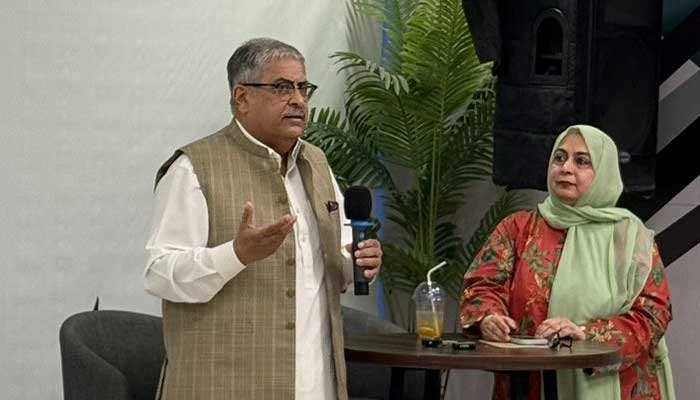
Supreme Court Justice Athar Minallah has voiced doubts about the independence of Pakistan’s judicial system, stating that the country needs “an independent judiciary and judges.” Speaking at an event organized by the Defence of Human Rights, he said, “If the state is involved in missing persons cases, the courts cannot do anything.”
Lamenting the difficulty of speaking the truth, and how the one who does “is hated the most,” the senior judge described cases involving missing persons as the “most difficult.” Justice Minallah’s remarks come against the backdrop of allegations of human rights violations concerning enforced disappearances, a charge vehemently denied by the government and state institutions.
The judge’s call for an independent judiciary is particularly significant in the context of a 2024 letter penned by five Islamabad High Court (IHC) judges to the Supreme Judicial Council (SJC), which complained of alleged interference by members of the executive, including intelligence agency operatives, in judicial affairs. The IHC judges who signed the letter include Justice Mohsin Akhtar Kiyani, Justice Tariq Mehmood Jahangiri, Justice Babar Sattar, Justice Sardar Ejaz Ishaq Khan, Justice Arbab Muhammad Tahir, and Justice Saman Fafat Imtiaz.
Earlier this week, a National Judicial Policy Making Committee (NJPMC) meeting, led by Chief Justice Yahya Afridi, decided that any judge facing external interference must lodge a complaint within 24 hours.
Recalling a previous judgment he gave on the missing persons issue, Justice Minallah said it had positive effects for four years. “I told my officer that I cannot tolerate missing persons cases in my area,” he said. “I said in the decision that no leniency will be shown to any government officer in the missing persons case.”
Stressing that the state’s job is to protect its citizens, the Supreme Court judge emphasized that the government is responsible for ensuring accountability and protecting everyone. “Every judge of the Supreme Court is responsible personally for every violation of fundamental rights that takes place in Pakistan,” he said. “Balochistan’s girls and women are crying on the streets; we should be ashamed.”
Stating that the issue is close to his heart, Justice Minallah recalled that students from Balochistan approached the IHC, where he had served before, despite the Supreme Court being a available forum. “People had faith in the IHC and used to approach it from all over the country because the judges [there] were independent,” he remarked, noting that the Baloch students’ case was not within his court’s jurisdiction. “I [even] wrote to the chief justice stressing that the violation of fundamental rights is the biggest issue… [However] nothing happened after I wrote the letter, I had no authority.”
Stressing that he always respected parliament and its elected members who have been “affected” for the past 77 years, Justice Minallah said that both the government and the judges apparently do not want to admit that missing persons are an issue in itself. “Those in the government have not been able to speak the truth for 77 years,” he remarked, adding that political parties completely change after going into opposition. “If we speak the truth, the situation will change. Everyone knows the truth, but not all of us want to know the truth,” the judge concluded.
