

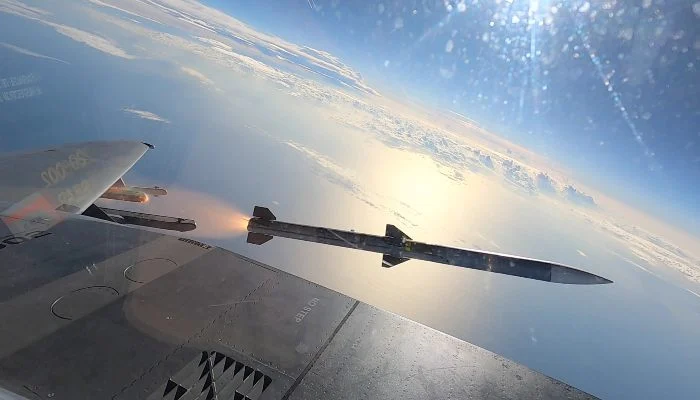
Months after Pakistani forces used Chinese-made ultra-long-range missiles to shoot down Indian fighter jets, new budget requests reveal that the U.S. is preparing to deploy its own next-generation weapon, the Lockheed Martin AIM-260, according to The News.
Citing budget documents and a service statement, Bloomberg reported that the U.S. Air Force and Navy have requested nearly $1 billion for the 2026 fiscal year, which begins October 1, to start production of the classified missile system.
The Air Force, which is leading the development of the AIM-260—formally known as the Joint Advanced Tactical Missile—has requested $368 million for its initial production run. An additional $300 million was listed in its annual “Unfunded Priorities List” submitted to congressional defense committees. The Navy has requested $301 million.
Analysts at Melius Research said last year that the missile program could become a $30 billion program, depending on the number of missiles produced. This would be a much-needed boost for Lockheed Martin, which recently reported a second-quarter earnings report that included $1.6 billion in charges and a potential $4.6 billion tax accounting liability.
“Profitable growth at MFC is extremely important for Lockheed Martin,” said Melius analyst Scott Mikus, referring to the company’s missiles and fire control division. “The key will be can they limit or avoid future charges on the classified missile program, which is believed to be the AIM-260,” he added.
When it is eventually fielded—the Air Force did not specify a timeline—the weapon will become the most advanced U.S. air-to-air missile. This role has long been held by the RTX Inc. AIM-120 AMRAAM, which was introduced in 1993 and has been progressively updated. The Air Force declined to say what developments gave the service the confidence to move into production now.
Air-launched weapons that can shoot down planes from extreme ranges gained prominence in May, when experts say Pakistani jets used Chinese-made PL-15 missiles to down Indian aircraft from more than 100 miles away, without risking return fire.
In its annual report on Chinese military power last year, the Pentagon stated that the Chinese air force likely declared the PL-17 air-to-air missile operational in 2023, saying the PL-15 follow-on “is believed to be able to strike targets from 400 kilometers (248 miles).”
The new U.S. missile “will have increased range over existing air-to-air weapons and will be effective in a variety of threat scenarios,” the Air Force said. A Ukrainian Air Force spokesman stated in 2023 that the AIM-120 model supplied to his country has a range of about 100 miles.
The AIM-260 is designed to fit the internal weapons bays of F-22 and F-35 fighters, but the Air Force said it would also be integrated with F-16 and F-15 jets.
