

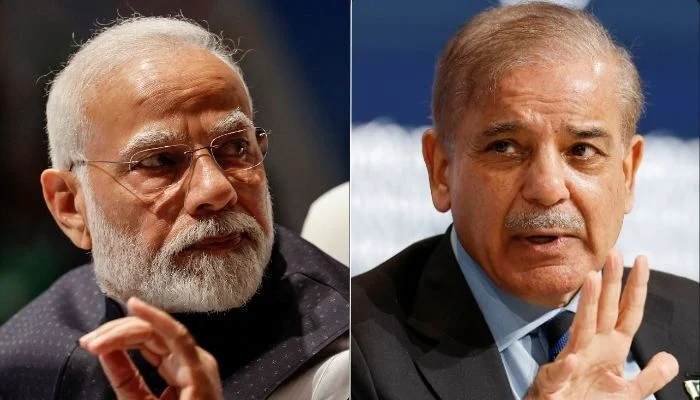
The Foreign Office on Friday dismissed speculation about a possible meeting between Prime Minister Shehbaz Sharif and his Indian counterpart, Narendra Modi, on the sidelines of the upcoming Shanghai Cooperation Organisation (SCO) Summit in China. During the weekly media briefing, Foreign Office spokesperson Shafqat Ali Khan reiterated Pakistan’s readiness for comprehensive dialogue with India, despite what he described as recent unprovoked missile attacks by New Delhi.
“India says they would talk on terrorism only; however, we want to talk on all matters, including terrorism, not just on terrorism. We will not hesitate from discussion on terrorism. We have complete and detailed evidence about India’s acts of terrorism against Pakistan, but this would just be one item during the composite dialogue,” the spokesperson said. He was responding to a query about Deputy Prime Minister and Foreign Minister Ishaq Dar’s earlier remarks, in which Dar stated that Pakistan was ready for collective dialogue with India, a position also expressed during the ceasefire brokered between the two countries.
When asked if any friendly country was working behind the scenes for a rapprochement, the spokesperson said, “Regarding efforts of our friendly countries, we welcome all the efforts because the direction of our policy is very clear, and we are ready for composite dialogue. We welcome any effort which helps us achieve our objectives.” These efforts are reportedly being led by China, which seeks peace and stability in the region. This was evident from remarks made by Chinese Foreign Minister Wang Yi at a press stakeout at the Foreign Office on Thursday. He stated, “After my visit to India, Afghanistan and Pakistan, I have to say that South Asia’s development enjoys strong potential. A peaceful and prosperous South Asia serves the interest of all three countries and the region.” In New Delhi, China also supported Pakistan’s sacrifices in the ongoing terrorist attacks, with Chinese Ambassador to India Xu Feihong remarking at a Delhi conference on the SCO Summit 2025 that “Pakistan is a victim of terrorism.”
To a query about China’s warming relations with India, the spokesperson highlighted the strength of Pakistan-China relations, saying, “The Pakistan-China relationship stands on its own. There is decades of history, trust, and all-encompassing cooperation between the two countries. The most important point is that the relationship lives in the hearts of the people of the two countries. And we do not think our initiatives for regional cooperation involving China, our bilateral relationship with China, our growing economic relations, and our strategic cooperation with China can be affected by anything. The Pakistan-China relationship is a very sustainable, long-standing, and robust relationship.” He added that counter-terrorism cooperation was a crucial part of the partnership and that “China has been our friend and a reliable partner as we have endured all the challenges centered on terrorism.”
Regarding reports of continued harassment of Pakistani diplomats in India, Pakistan reiterated its firm belief in the dignified treatment of diplomats and the honoring of relevant international treaties. The spokesperson noted that Pakistan and India have a mutually agreed code of conduct on this subject, and its provisions should be fully respected and implemented. This statement came as the Indian High Commission also raised issues about the difficulties it faces in Islamabad.
As Pakistan once again faced terrorist attacks from the TTP based inside Afghanistan, the spokesperson maintained a public stance of patience, repeating the standard policy: “Terrorist elements enjoying sanctuaries in Afghanistan have been a constant issue bedeviling the full potential of Pakistan-Afghanistan relations. It continues to be an important topic of our conversation with the Afghans, and similarly, in the trilateral format (with China). We hope Afghan authorities would respond to our legitimate concerns.”
The spokesperson also expressed alarm over India’s arms buildup, stating, “We notice the arms accumulation or the procurement. It becomes more sinister when you look at their declaratory policy and the domestic developments in India, which are so hostile towards Pakistan, and increasingly Islamophobic. It is dangerous not only for Pakistan’s security but also for regional stability.” He warned that the international community’s “blind eye to India’s mad rush to develop military capabilities is a very dangerous trend.” However, he added, “We remain ready and we have enough capability to respond effectively and defend our territory, our sovereignty and our country to any threat or action from India in this regard.”
Commenting on the Indian Agni missile test, he said, “The acquisition and testing of intercontinental ballistic missile capabilities reflects a growing military threat posed by India extending far beyond the region and even the continent. This development seriously undermines peace, security and strategic stability at both regional and global levels.” He added that the selective and discriminatory application of Export Control Regulations had enabled such destabilizing advancements. Pakistan, he said, remains committed to maintaining full-spectrum deterrence.
Regarding reports of a meeting of anti-Taliban personalities in Pakistan on August 25th and 26th, the spokesperson clarified that the event was being organized by a think tank and should not be equated with the state’s position. “Since it is a think tank activity, it should not be equated with the state position. Secondly, if a think tank is doing something in the open and not secretly, it should not be a source of concern. It just got a bit sensationalized by some of the social media platforms and figures.” He repeated that it was not a state-sponsored activity.
When asked about a possible visit by US Secretary of State, the spokesperson said that while high-level visits are always discussed, there were no plans for a visit by Secretary Rubio to Pakistan in October. Finally, he announced that Deputy Prime Minister Dar would pay an official visit to Bangladesh on August 23-24 to hold meetings with various Bangladeshi leaders, including Chief Adviser Muhammad Yunus, and Adviser for Foreign Affairs, Md Touhid Hossain.
