

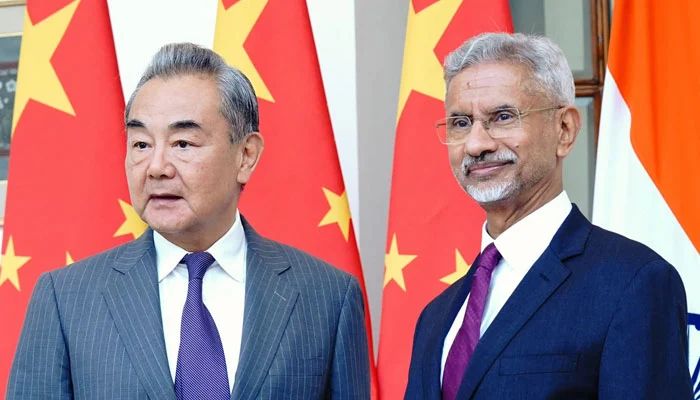
According to his ministry, Chinese Foreign Minister Wang Yi told his Indian counterpart on Monday that China and India should establish a “correct strategic understanding” and see each other as partners, not rivals.
A Chinese readout of the ministers’ meeting in New Delhi showed that China is ready to uphold the principle of cordiality and mutual benefit with India. Earlier, he and his Indian counterpart, Subrahmanyam Jaishankar, discussed border peace, trade issues, and bilateral exchanges, with the goal of strengthening cooperation between the two nations.
“We had productive conversations on our economic and trade issues, pilgrimages, people-to-people contacts, river data sharing, border trade, connectivity, and bilateral exchanges,” Jaishankar said. He added that the discussions would help build a stable, cooperative, and forward-looking relationship between India and China.
A Chinese readout noted that exchanges and dialogue at all levels between both countries have been gradually restored, and bilateral relations are returning to cooperation. Wang also urged both sides, as major countries, to set an example for other developing countries to unite and strengthen themselves.
The statement quoted Wang as saying that China and India should establish “correct strategic understanding, regard each other as partners and opportunities, not as rivals or threats.”
Wang arrived in the Indian capital on Monday for a two-day visit, during which he will hold the 24th round of border talks with Indian National Security Adviser Ajit Doval and also meet with Prime Minister Narendra Modi.
Earlier in the day, Jaishankar had said that discussing border issues was very important because the foundation for any positive progress in India-China ties was the ability to jointly maintain peace in border areas.
“Having seen a difficult period in our relationship, our two nations now seek to move ahead. This requires a candid and constructive approach from both sides,” Jaishankar told Wang in his opening remarks. He also stated that it is crucial for the two countries to pull back their troops that have been amassed along their disputed border in the western Himalayas since a deadly border clash in 2020.
Wang’s visit comes just days before Modi travels to China—his first visit in seven years—to attend the summit of the Shanghai Cooperation Organisation, a regional political and security group that also includes Russia.
Relations between the Asian giants began to thaw in October after New Delhi and Beijing reached a milestone pact to lower military tensions on their Himalayan border following talks between Chinese President Xi Jinping and Modi in Russia.
Ties between the two countries had sharply deteriorated following a military clash on that border in the summer of 2020, in which 20 soldiers from India and four from China were killed.
