

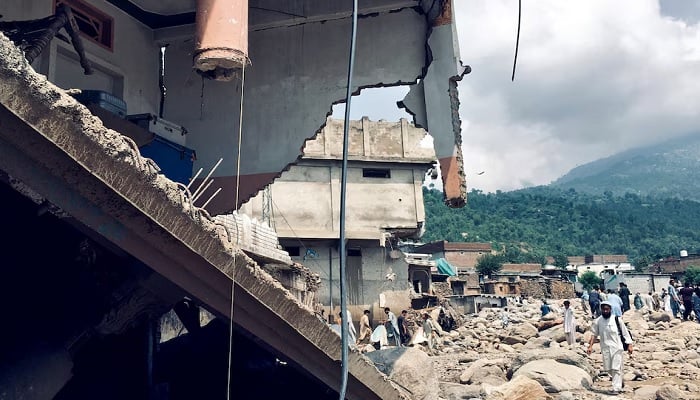
In Swat’s Mangalore area of Khyber Pakhtunkhwa, a raging flood tore through a government primary school, damaging its walls and classrooms. However, the headmaster’s quick thinking saved nearly 950 students. The headmaster, Saeed Ahmed, told Geo News that he noticed the water level in a nearby stream rising rapidly on the morning the flood hit.
Without a moment’s hesitation, he ordered his teachers to immediately send the children home. Minutes later, the floodwaters surged into the school, toppling the boundary wall and inundating classrooms and offices. In just five minutes, the entire school was submerged. But by then, all 936 students had been safely moved out, with not a single life lost.
Ahmed’s presence of mind prevented a school from becoming a site of tragedy. Standing among the building’s ruins, he appealed to the government for swift action to rebuild the school so children could return to their studies.
Widespread Devastation and Growing Death Toll
Rescuers worked on Sunday to dig homes out from under massive boulders as they searched for survivors of flash floods in northern Pakistan. The nationwide death toll from rain-related incidents has now surpassed 300, with most casualties in KP, Gilgit-Baltistan, and Azad Jammu and Kashmir. Torrential rains since Thursday have caused widespread flooding and landslides that have swept away entire villages and left many residents trapped in debris.
On Saturday, hundreds of people gathered for mass funerals, where bodies wrapped in blood-stained white shawls were laid out on the ground in various areas. Fallen trees and debris were scattered across nearby fields, and residents shoveled mud out of their homes.
The country’s meteorological department has forecast “torrential rains” with monsoon activity “likely to intensify” from Sunday onwards. Iran and Pope Leo XIV have offered support and prayers for the victims of the disaster.
The Double-Edged Sword of the Monsoon
The monsoon season provides South Asia with about three-quarters of its annual rainfall, which is vital for agriculture and food security, but it also brings immense destruction. The chairman of the national disaster agency, Lieutenant General Inam Haider, stated that this year’s monsoon intensity is 50 to 60 percent more than last year’s, with two to three more spells expected until September. Pakistan is one of the world’s most vulnerable countries to the effects of climate change and is experiencing extreme weather events with increasing frequency. The 2022 monsoon floods submerged a third of the country and killed around 1,700 people.
