

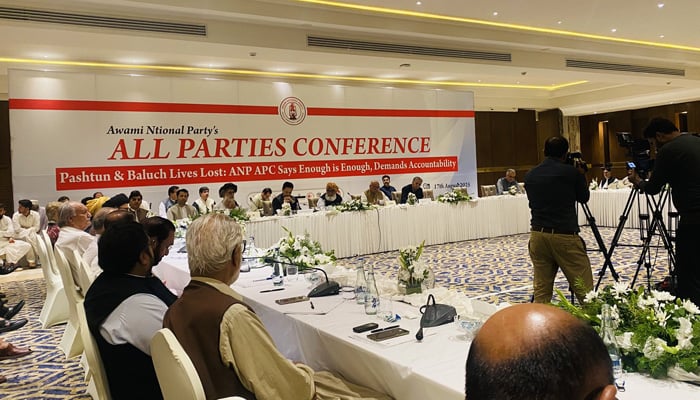
An All Parties Conference (APC) hosted by the Awami National Party (ANP) ended in disagreement on Sunday after the key government allies, Pakistan Muslim League-Nawaz (PML-N) and Pakistan Peoples Party (PPP), declined to endorse the joint declaration. This public discord highlighted deep-seated political divisions, even as the conference was convened to address critical issues in Khyber Pakhtunkhwa and Balochistan.
The conference, initiated by ANP President Aimal Wali Khan and attended by 19 political parties, aimed to address the deteriorating security situation, resource mismanagement, and political grievances in the merged districts and Balochistan. However, the event concluded without a unified front when PML-N Senator Irfan Siddiqui and PPP Secretary General Nayyar Hussain Bukhari refused to sign the final declaration.
Justifying their decision, Senator Siddiqui stated that his party could not agree with certain demands outlined in the declaration. He called for a broader national dialogue, urging leaders to move beyond inter-provincial grievances and focus on national unity. He praised the armed forces and stressed the importance of upholding the 1973 Constitution.
PPP’s Bukhari echoed a similar position, underscoring his party’s commitment to parliamentary continuity and the Constitution. He dismissed the idea of a “new social contract,” insisting that any talks must occur within the existing constitutional framework. He also rejected dialogue with groups acting as proxies for foreign powers and engaging in terrorism.
Earlier, JUI-F chief Maulana Fazlur Rehman set a confrontational tone, alleging that armed groups were extorting 10% of government funds in tribal regions. He demanded that profits from the natural resources of Khyber Pakhtunkhwa and Balochistan should benefit local communities. He also criticized the revival of traditional jirgas and questioned the credibility of the country’s parliamentary system, arguing that “stealing the public mandate” was unacceptable.
Despite the withdrawal of the PML-N and PPP, the remaining parties adopted the declaration, which demanded the full implementation of the 18th Constitutional Amendment and an end to military operations in Khyber Pakhtunkhwa and Balochistan. The declaration called for a judicial truth commission to investigate the human and financial costs of these operations, and for an end to enforced disappearances. It also condemned the forced repatriation of Afghan refugees, urging that they be allowed to complete their education.
