

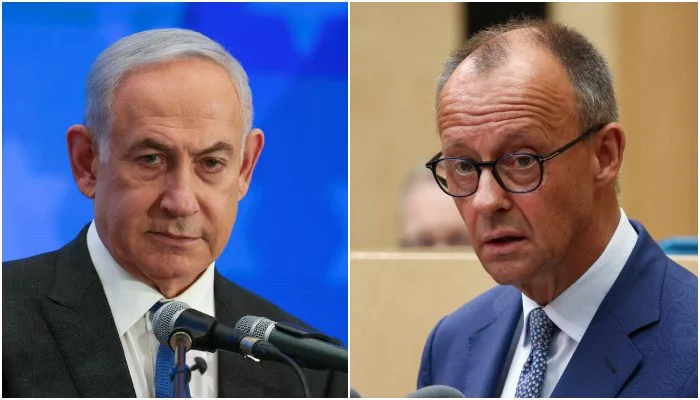
Driven by mounting public outrage over the escalating humanitarian crisis in Gaza and Israel’s intentions to expand its military control over the territory, Germany has taken the sensitive step of curbing arms exports to Israel.
Conservative Chancellor Friedrich Merz, a leader previously known for his strong pro-Israel stance, announced the decision on Friday. He argued that Israel’s actions would not achieve its declared war objectives of eliminating Hamas or securing the release of Israeli hostages.
This is a notable move for Merz, who after winning the elections in February, had stated he would invite Israeli Prime Minister Benjamin Netanyahu to Germany, despite an arrest warrant issued against him by the International Criminal Court (ICC).
The policy shift demonstrates how Germany’s steadfast support for Israel, which is deeply rooted in its historical guilt over the Nazi Holocaust, is being challenged like never before. The high number of Palestinian civilian casualties in Gaza, widespread devastation, and images of starving children are eroding a decades-old policy.
According to Muriel Asseburg, a researcher at the German Institute for International and Security Affairs, “It is remarkable as it is the first concrete measure of this German government. But I would not see it as a U-turn, rather a ‘warning shot’.”
The decision comes after months of the German government gradually adopting a sharper tone regarding Israel’s intensified military campaign in the densely populated Palestinian enclave. However, it still falls short of the tougher measures that some other European nations and voices within Merz’s own coalition have been advocating for.
The suspension of arms deliveries to Israel will specifically impact only those that could be used in Gaza.
This action reflects a hardening public mood in Germany, where opinion has become increasingly critical of Israel and more demanding that the government assist in alleviating the humanitarian disaster. A recent ARD-DeutschlandTREND survey revealed that 66% of Germans want their government to exert more pressure on Israel to alter its conduct.
Perhaps most significantly, only 31% of Germans now feel they have a special responsibility for Israel due to their history—a cornerstone of German foreign policy—while 62% do not share this sentiment.
Merz’s junior coalition partner, the Social Democrats (SPD), had already been more vocal about considering sanctions against Israel. Adis Ahmetovic, an SPD foreign policy spokesperson, stated that suspending arms shipments was only the first step.
“More must follow, such as a full or partial suspension of the [European Union] Association Agreement or the medical evacuation of seriously injured children,” he told Stern magazine. “Furthermore, sanctions against Israeli ministers must no longer be taboo.”
The deepening divisions are also apparent in Germany’s media landscape. Editorials in Der Spiegel have accused Israel of violating international humanitarian law and the German government of complicity, while the mass-market daily Bild has highlighted what it sees as growing anti-Israel sentiment and one-sided protests.
Critics argue that Germany’s cautious approach has weakened the West’s collective ability to apply meaningful pressure for a ceasefire and for increased humanitarian aid to the Israeli-besieged enclave.
Israel denies having a policy of starvation in Gaza, stating that Hamas could end the crisis by surrendering. According to Gaza’s health ministry, Israel’s ground and air war has killed over 60,000 Palestinians.
Analysts suggest that Germany’s reluctance to criticize Israel extends beyond its Nazi past, citing its robust trading relationship with Israel and the US. Germany is Israel’s second-largest weapons supplier after the US, but also purchases arms from Israel.
“German arrogance should be avoided,” said Volker Beck, the head of the German-Israeli Society. “If Israel were to retaliate by restricting arms deliveries to Germany, the future of German air security would look grim.”
