

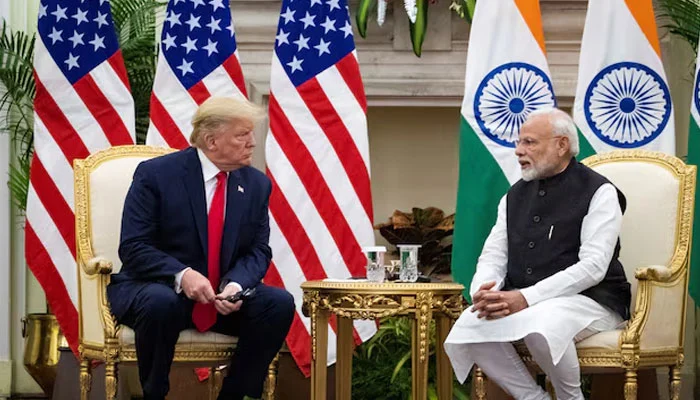
In his first public comments after US President Donald Trump’s imposition of a 50% tariff on Indian goods, Prime Minister Narendra Modi declared on Thursday that he will not compromise on the interests of the country’s farmers, even if it comes at a heavy personal cost. Trump’s decision to impose an additional 25% tariff on Thursday brings the total levy on Indian goods to 50%, one of the highest applied to any US trading partner.
“For us, our farmers’ welfare is supreme,” Modi stated at an event in New Delhi. “India will never compromise on the well-being of its farmers, dairy sector and fishermen. I know personally I will have to pay a heavy price for it.”
The new tariff, effective from August 28, is a penalty for India’s continued purchase of Russian oil, which Trump has cited as a key issue. Trade negotiations between the two countries had previously collapsed over disagreements on opening up India’s farm and dairy sectors and halting Russian oil imports. While Modi did not explicitly name the US or the tariffs, his message was a clear response to the ongoing trade dispute.
India’s foreign ministry has called the decision “extremely unfortunate,” vowing that “India will take all necessary steps to protect its national interests.” The US has not announced similar tariffs for China, the largest buyer of Russian oil, which experts attribute to China’s leverage with its reserves of rare earth minerals.
Dammu Ravi, secretary of economic relations in India’s foreign ministry, told reporters that the US tariff hike “lacks logic” and is a “temporary aberration.” He expressed confidence that the country would find solutions over time.
In a move signaling a potential shift in its foreign policy, India has started exploring other partnerships. Prime Minister Modi is preparing for his first visit to China in over seven years, which suggests a possible realignment of alliances as relations with Washington sour. Brazilian President Luiz Inacio Lula da Silva also announced that he would initiate a conversation among the BRICS nations—Brazil, Russia, India, China, and South Africa—to discuss a collective response to Trump’s tariffs.
Indian exporters are already expressing concern, warning that the additional US tariffs could make their businesses “not viable.” S.C. Ralhan, president of the Federation of Indian Export Organisations (FIEO), called the move a “severe setback” for Indian exports, affecting nearly 55% of shipments to the US. He noted that the 50% tariff puts Indian exporters at a 30-35% competitive disadvantage and has already led to many export orders being put on hold.
The world’s fifth-largest economy is now bracing for a difficult period, as the US is its largest trading partner, with bilateral trade amounting to $87.4 billion in 2024.
