

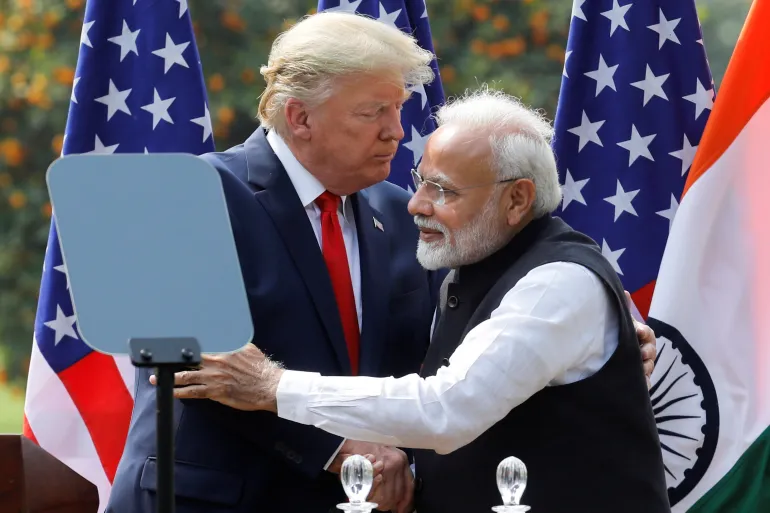
After a period of perceived closeness between their leaders, a harsh reality has now set in for New Delhi. President Donald Trump first hit India with a 25 percent tariff on imports in late July, and then, on Wednesday, he doubled it to 50 percent. This escalation is a direct result of India’s continued oil purchases from Russia, as the U.S. tries to compel Moscow into a ceasefire in the war on Ukraine.
In response to the announcement of the additional tariffs, a spokesperson for the Indian government stated, “We have already made clear our position on these issues, including the fact that our imports are based on market factors and done with the overall objective of ensuring the energy security of 1.4 billion people of India.” The spokesperson added that it was “extremely unfortunate that the US should choose to impose additional tariffs on India for actions that several other countries are also taking in their own national interest.” India reiterated that the tariffs were “unfair, unjustified and unreasonable” and pledged to “take all actions necessary to protect its national interests.”
According to some experts, a trade deal between India and the U.S. remains elusive, and bilateral relations are on a “slippery slope.” A trade economist, Biswajit Dhar, told Al Jazeera that “US-India relations are at the lowest point in decades.” He highlighted that dozens of other countries, including India’s neighbors, Pakistan and Bangladesh, face lower tariffs.
In a defiant address at a public rally, Prime Minister Modi took a strong stance against Trump’s trade measures. “The world economy is going through many apprehensions… an atmosphere of instability,” Modi said. He added a new focus on self-reliance, stating, “Now, whatever we buy, there should be only one scale: we will buy those things which have been made by the sweat of an Indian.” This came as Indian officials reportedly continued to reject calls to stop purchasing Russian crude.
On his Truth Social platform, Trump directly accused India of helping to fund the conflict in Ukraine. “They [Indians] don’t care how many people in Ukraine are being killed by the Russian War Machine,” Trump wrote, justifying his decision to “substantially” raise tariffs.
Points of Contention in U.S.-India Relations
Despite the personal rapport between Modi and Trump, several key areas of discord are driving the wedge between the two countries:
- A Failed Trade Deal: Trade has consistently been a point of friction. The U.S. has pushed for greater market access and lower tariffs for its exports, while India has resisted, citing the need to protect its domestic industries and small farmers. Disagreements over e-commerce, data flows, and price controls on medical devices have reportedly stalled progress.
- India’s Close Ties with Russia: As Trump’s frustration with Russia grows, India’s long-standing relationship with Moscow has become a key target. Analysts say that while the U.S. sees India as a partner against China, it is increasingly uneasy with New Delhi’s continued defense and energy ties with Moscow. Modi has maintained a close relationship with Vladimir Putin, even receiving Russia’s highest civilian honor.
- Kashmir Ceasefire Claim: Following a military conflict between India and Pakistan in Kashmir, Trump claimed he intervened to broker a ceasefire, threatening trade as a lever. This claim has sparked criticism in India, which maintains that all disputes with Pakistan must be resolved bilaterally without third-party mediation.
- Growing US-Pakistan Relations: In a move that surprised many, Trump hosted Pakistan’s army chief at the White House, underscoring a new warmth between Washington and Islamabad after years of strained relations.
- Immigration and Tech Hiring: The Trump administration has also come under fire for its treatment of Indian nationals being deported and for its crackdown on H1B work visas. In a recent speech, Trump singled out tech giants for hiring Indian workers and urged them to prioritize Americans.
What’s Next for the Relationship?
Experts believe it is highly improbable that India will abandon its policy of “strategic autonomy” to appease Trump. Michael Kugelman of the Wilson Center stated that US-India relations have “sunk to their lowest level during the last two decades of strategic partnership.” He noted that India’s non-alignment with foreign powers is “a critical component of India’s foreign policy” and that New Delhi is likely to “double down” on it in the face of pressure. Jayati Ghosh, an economics professor at the University of Massachusetts Amherst, emphasized the absurdity of expecting a country with a population larger than the U.S. and Europe combined to give up its strategic independence. Ultimately, analysts suggest that India may be hoping that if Russia agrees to a ceasefire, Trump’s frustration will abate, allowing the relationship to recover.
This video provides an overview of President Trump’s announcement of an additional 25% tariff on India for its purchase of Russian crude oil. Trump signs executive order; imposes 25% extra tariff on India over Russian oil purchase
