

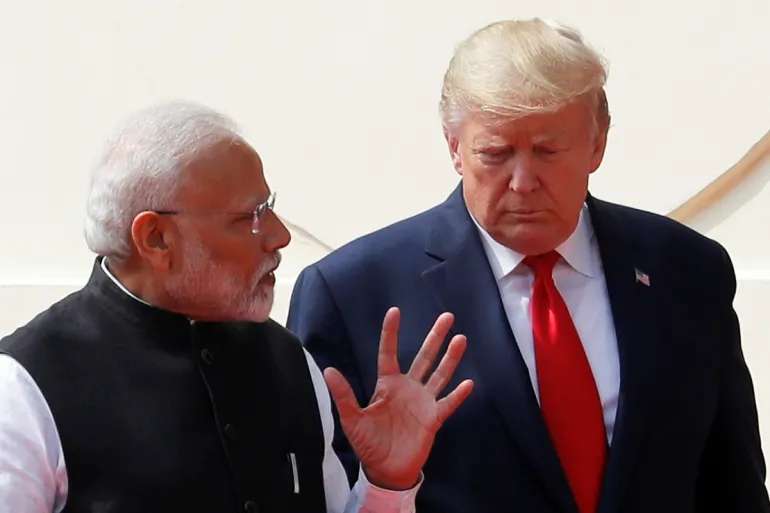
In a newly issued executive order, President Donald Trump has declared that Russia’s ongoing military activities in Ukraine constitute a “national emergency,” making it “necessary and appropriate” to impose heightened tariffs on India, a significant buyer of Russian petroleum products.
“I find that the Government of India is currently directly or indirectly importing Russian Federation oil,” Trump’s order stated. He added that “The actions and policies of the Government of the Russian Federation continue to pose an unusual and extraordinary threat to the national security and foreign policy of the United States.”
The tariff increase is scheduled to take effect 21 days after the announcement, providing a window for India and the U.S. to potentially negotiate a reduced rate. However, the move is poised to further strain U.S.-Indian relations. Brazil is the only other country facing the same 50-percent overall tariff rate.
Strained U.S.-India Relations
This announcement follows five rounds of trade discussions between India and the U.S., with U.S. Vice President JD Vance even traveling to New Delhi in April to lead the negotiations. Yet, months of talks have failed to yield a trade agreement, and analysts suggest that U.S.-India ties are now confronting their most severe crisis in years.
Experts have pointed out that India’s inability to finalize a deal with Trump stands in contrast to its neighbor and rival, Pakistan, which successfully negotiated a lower tariff rate in July.
The timing of this announcement also coincides with reports that Indian Prime Minister Narendra Modi is slated to visit China later this month for the first time in over seven years. According to an Indian government source who spoke to Reuters, Modi will attend a security summit in Tianjin, a development signaling an easing of tensions with China, where Russian officials are also expected to be in attendance.
Until recently, the personal relationship between Trump and Modi was considered exceptionally close. Modi was among the first foreign leaders to visit Trump after the Republican leader’s second inauguration in January. During his first term in 2019, Trump hosted a special rally for the Indian prime minister in Texas, titled “Howdy Modi.” For his part, Modi has embraced Trump’s “Make America Great Again” mantra with his own version: “Make India Great Again.”
However, Trump has been vocal about his belief that India’s economic practices are unfair to the U.S. and has vowed to reduce trade deficits with foreign partners. According to U.S. government trade data, India exported nearly $87.3 billion in goods and services to the U.S. in 2024, far outpacing U.S. exports to India, which totaled $41.5 billion.
Pressure to End Ukraine War
Trump’s frustration has also grown with Russia, despite his previously warm relationship with President Vladimir Putin. Upon taking office for a second term, he positioned himself as a “peacemaker” after walking back a previous “sarcastic” pledge to end the war within 24 hours.
He has pressed forward with peace negotiations, but with no ceasefire in sight, Trump announced a deadline in July for Russia to wind down its military campaign—a deadline that expired on Wednesday.
In his executive order, Trump did leave open the possibility that other importers of Russian oil could also be subjected to higher tariffs. He also reserved the right to “modify” the order if any retaliatory action is taken or if countries like India “take significant steps” to align with U.S. policy objectives.
This tariff announcement followed meetings by Trump’s top diplomatic envoy, Steve Witkoff, in Moscow aimed at pushing Russia toward peace in Ukraine. Separately, Indian National Security Adviser Ajit Doval was also in Russia this week, reportedly discussing pressure to end Indian purchases of Russian petrol.
